
Feet to inches is the simplest imperial conversion and one of the most frequent — converting a height to a single number for a form, working out the baseboard for a 12-foot wall, or feeding dimensions into a tool that only takes inches. It’s a multiplication by 12, and 12 is exact: there are precisely twelve inches in a foot, with no regional variation.
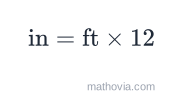
The feet to inches formula
Decimal feet work in the same formula. For a metric result, multiply the inches by 2.54 to get centimetres.
Worked example
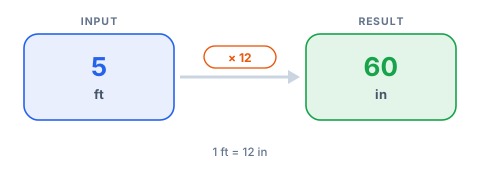
The calculator’s default is 5 feet.
For a decimal input like 5.75 feet:
which confirms 5.75 ft = 5 ft 9 in = 69 in. In centimetres, 5 feet is
What Your Results Mean
The Inches result gives you the total inch count, useful for material calculations, height conversions, and data entry. The Centimeters result provides a metric equivalent for international contexts.
Decimal feet vs. feet-and-inches
Construction plans sometimes use decimal feet (5.5 ft) while conversations use feet-and-inches (5’6”). They’re the same thing: 0.5 feet = 6 inches, 0.25 feet = 3 inches, 0.75 feet = 9 inches. This calculator handles both forms since decimal feet produce decimal inches that resolve to exact values.
Height conversion reference
| Feet | Decimal Feet | Inches |
|---|---|---|
| 4’0” | 4.0 | 48 |
| 4’1” | 4.08 | 49 |
| 4’2” | 4.17 | 50 |
| 4’3” | 4.25 | 51 |
| 4’4” | 4.33 | 52 |
| 4’5” | 4.42 | 53 |
| 4’6” | 4.5 | 54 |
| 4’7” | 4.58 | 55 |
| 4’8” | 4.67 | 56 |
| 4’9” | 4.75 | 57 |
| 4’10” | 4.83 | 58 |
| 4’11” | 4.92 | 59 |
| 5’0” | 5.0 | 60 |
| 5’1” | 5.08 | 61 |
| 5’2” | 5.17 | 62 |
| 5’3” | 5.25 | 63 |
| 5’4” | 5.33 | 64 |
| 5’5” | 5.42 | 65 |
| 5’6” | 5.5 | 66 |
| 5’7” | 5.58 | 67 |
| 5’8” | 5.67 | 68 |
| 5’9” | 5.75 | 69 |
| 5’10” | 5.83 | 70 |
| 5’11” | 5.92 | 71 |
| 6’0” | 6.0 | 72 |
| 6’1” | 6.08 | 73 |
| 6’2” | 6.17 | 74 |
| 6’3” | 6.25 | 75 |
| 6’4” | 6.33 | 76 |
| 6’5” | 6.42 | 77 |
| 6’6” | 6.5 | 78 |
| 6’7” | 6.58 | 79 |
| 6’8” | 6.67 | 80 |
| 6’9” | 6.75 | 81 |
| 6’10” | 6.83 | 82 |
| 6’11” | 6.92 | 83 |
| 7’0” | 7.0 | 84 |
Need to go the other way? The inches to feet converter divides by 12. For metric outputs, the inches to cm calculator takes your inch result further, or use the inches to meters converter for larger measurements in SI units.
Converting feet and inches together
Most real measurements come as feet and inches. Convert the feet, then add the inches on top. A cut list calls for three shelves at 4 ft 7 in each:
To turn 165 inches back into feet and inches, divide by 12:
Square and cubic feet are different
The factor of 12 only works for length. An area has two dimensions, so each square foot holds
Using 12 for an area undercounts by a factor of 12, a mistake that shows up regularly in tile and paint estimates.
Common mistakes
- Reading 5’9” as 5.9 feet. 5.9 ft is
inches, not 69. The 9 is inches, not tenths of a foot. - Multiplying by 10. Imperial units aren’t decimal. A foot is 12 inches, so 3 ft is 36 in, not 30.
- Using 12 for area or volume. Square feet need 144; cubic feet need 1728.
- Mixing up the tick marks. One tick (’) means feet and two (”) mean inches. 6’ is six feet; 6” is six inches.