
Inches to feet is one of the most common everyday conversions — sizing a room, stating a height, turning a tape-measure reading into a plan dimension. It’s a division by 12, with an optional second step to express the answer as feet-and-inches rather than decimal feet, since “5 ft 9 in” is how people actually talk while “5.75 ft” is how a spreadsheet wants it.
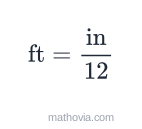
The inches to feet formula
To split into whole feet and leftover inches:
Worked example
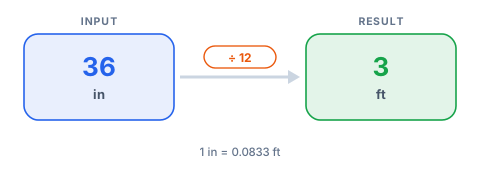
The calculator’s default is 36 inches.
36 divides evenly, so it’s exactly 3 feet (one yard) with nothing left over. A value that doesn’t divide evenly, like 50 inches:
What Your Results Mean
The Feet result gives you the exact decimal equivalent, useful for calculations in spreadsheets or engineering software. The Whole Feet and Remaining Inches fields give you the practical breakdown you’d use when reading a tape measure or stating someone’s height (e.g., 5 ft 9 in rather than 5.75 ft).
When decimal feet matter
Decimal feet are standard in surveying and some CAD applications. A land survey might list a property line as 125.33 ft rather than 125 ft 4 in. If you’re working with decimal feet and need to go the other direction, the feet to inches converter handles that instantly.
Common inches-to-feet reference points
- 12 inches to feet = 1 foot
- 18 inches to feet = 1.5 feet
- 24 inches to feet = 2 feet
- 30 inches to feet = 2.5 feet
- 36 inches to feet = 3 feet (one yard)
- 42 inches to feet = 3.5 feet
- 48 inches to feet = 4 feet
- 54 inches to feet = 4.5 feet
- 60 inches to feet = 5 feet (common height threshold)
- 66 inches to feet = 5.5 feet
- 72 inches to feet = 6 feet
- 78 inches to feet = 6.5 feet
- 84 inches to feet = 7 feet
- 90 inches to feet = 7.5 feet
- 96 inches to feet = 8 feet
- 102 inches to feet = 8.5 feet
- 108 inches to feet = 9 feet
- 114 inches to feet = 9.5 feet
- 120 inches to feet = 10 feet
- 132 inches to feet = 11 feet
- 144 inches to feet = 12 feet
- 156 inches to feet = 13 feet
- 168 inches to feet = 14 feet
- 180 inches to feet = 15 feet
- 192 inches to feet = 16 feet
- 204 inches to feet = 17 feet
- 216 inches to feet = 18 feet
- 228 inches to feet = 19 feet
- 240 inches to feet = 20 feet
If you’re converting to metric instead, try the inches to cm converter or the inches to meters converter for larger measurements. For fractional inch work, the inches to fraction calculator breaks decimals into ruler-friendly fractions like 3/16 or 7/32.
Adding feet and inches
Add the feet and the inches separately, then carry any 12 inches over into a foot. For 5 ft 9 in plus 3 ft 8 in:
Converting both to inches first works too:
Square inches to square feet
For area, divide by 144, not 12. A 24 × 36 inch panel has an area of 864 square inches:
Common mistakes
- Reading 5.5 ft as 5 ft 5 in. Half a foot is 6 inches, so 5.5 ft is 5 ft 6 in.
- Dividing by 10. There are 12 inches in a foot, so 30 inches is 2.5 ft, not 3 ft.
- Using 12 for areas. Square inches to square feet uses 144.
- Rounding the decimal before converting. 67.5 in is 5.625 ft. Rounding to 5.6 ft first gives 5 ft 7.2 in instead of 5 ft 7.5 in.