
Converting inches to centimetres is the everyday bridge between the imperial and metric worlds — needed the moment you order clothing from an overseas site, read a European furniture spec, compare a TV’s advertised size to the space on your wall, or follow a sewing or woodworking pattern from another country. The factor is exact: one inch is defined as 2.54 centimetres, so there’s no rounding hidden in the conversion.
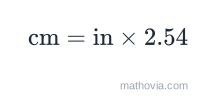
The inches to cm formula
That’s the whole conversion. For metres, divide the result by 100; for millimetres, multiply the inches by 25.4 instead.
Worked example
The calculator’s default is 12 inches.
Twelve inches is one foot, so 30.48 cm is a number worth memorising — it anchors a lot of quick estimates. In metres:
A fractional example: 3⅜ inches becomes 3.375 inches, and
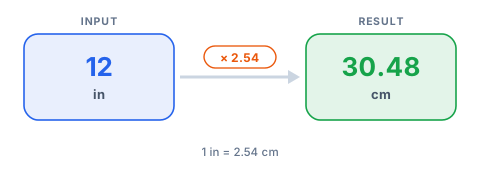
What Your Results Mean
The Centimeters result is your primary conversion, useful for any metric context. The Meters Equivalent saves you a second calculation when you need the result in meters for scientific or construction applications.
Practical applications
Body measurements for international clothing sizes are always in centimeters. A 32-inch waist is 81.28 cm. TV and monitor screens advertised as “55 inches” are 139.7 cm diagonal. Paper sizes like A4 (29.7 x 21.0 cm) often need comparison with US Letter (11 x 8.5 inches = 27.94 x 21.59 cm).
Everyday cm to inches conversion references
- 1 cm to inches = 0.39 inches
- 2.54 cm to inches = 1 inch (exact)
- 5 cm to inches = 1.97 inches
- 10 cm to inches = 3.94 inches
- 15 cm to inches = 5.91 inches
- 20 cm to inches = 7.87 inches
- 25 cm to inches = 9.84 inches
- 30 cm to inches = 11.81 inches
- 40 cm to inches = 15.75 inches
- 50 cm to inches = 19.69 inches
- 60 cm to inches = 23.62 inches
- 70 cm to inches = 27.56 inches
- 80 cm to inches = 31.50 inches
- 90 cm to inches = 35.43 inches
- 100 cm to inches = 39.37 inches
- 110 cm to inches = 43.31 inches
- 120 cm to inches = 47.24 inches
- 130 cm to inches = 51.18 inches
- 140 cm to inches = 55.12 inches
- 150 cm to inches = 59.06 inches
- 152 cm to inches = 59.84 inches (about 5 feet)
- 160 cm to inches = 62.99 inches (about 5 feet 3 inches)
- 165 cm to inches = 64.96 inches (about 5 feet 5 inches)
- 170 cm to inches = 66.93 inches (about 5 feet 7 inches)
- 175 cm to inches = 68.90 inches (about 5 feet 9 inches)
- 180 cm to inches = 70.87 inches (about 5 feet 11 inches)
- 183 cm to inches = 72.05 inches (about 6 feet)
- 185 cm to inches = 72.83 inches (about 6 feet 1 inch)
- 190 cm to inches = 74.80 inches (about 6 feet 3 inches)
- 195 cm to inches = 76.77 inches (about 6 feet 5 inches)
- 200 cm to inches = 78.74 inches (about 6 feet 7 inches)
- 210 cm to inches = 82.68 inches (about 6 feet 11 inches)
- 220 cm to inches = 86.61 inches (about 7 feet 3 inches)
If you need millimeter precision for machining or 3D printing, use the inches to mm converter instead. To go the other direction, the cm to inches calculator reverses this conversion. For fractional inch inputs (like 3/8”), convert to decimal first with the inches fraction to decimal tool, then convert to centimeters here.
Converting in your head
Multiply by 2.5, then add a little. For 12 inches,
Square inches to square centimetres
For area, multiply by
Common mistakes
- Dividing instead of multiplying. Centimetres are smaller than inches, so the cm number must be larger.
- Typing a fraction as a decimal.
inches is 3.375, not 3.38 or 3.3. Convert the fraction exactly first: 3.375 in is 8.5725 cm. - Using 2.5 for precise work. Over 40 inches, the shortcut is 1.6 cm short.
- Mixing up cm and mm. Multiply by 25.4 for millimetres.