
Understanding the Btu/h to Watts Conversion
BTU per hour is the standard power rating for heating and cooling equipment in the United States, while watts dominate international specifications and electrical engineering. When you need to compare a US-rated furnace against a metric-rated heat pump, or figure out how much electrical capacity an HVAC system demands, converting between these units is unavoidable.
A common mistake is confusing BTU (energy) with BTU per hour (power). Equipment spec sheets nearly always mean Btu/h when they say “BTU” in a capacity context, but mixing them up leads to calculations that are off by a factor of 3,600. Another frequent error is using rounded conversion factors that accumulate meaningful error at scale, particularly when sizing commercial systems rated in hundreds of thousands of Btu/h.
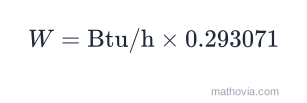
The Btu/h to watts formula
The factor comes straight from the definitions. One BTU is about 1,055.06 joules, and there are 3,600 seconds in an hour, so:
Worked example
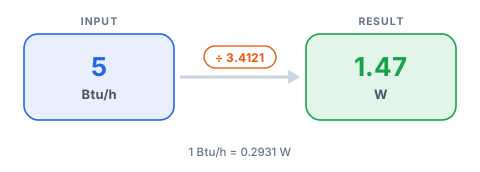
The calculator’s default is 5 Btu/h.
A more practical case: a 12,000 Btu/h room air conditioner (a “1-ton” unit).
What the watt figure means
The watt value is the same rate of heat flow, in SI units — useful for comparing a US-rated furnace or AC against a metric-rated heat pump, or for lining up thermal capacity with an energy figure on a utility bill.
One caution: for a heat pump or air conditioner, the Btu/h capacity is not the electrical draw. A 12,000 Btu/h AC moves about 3.5 kW of heat while consuming roughly 1 to 1.5 kW of electricity, because it pumps heat rather than creating it. Only for a pure resistance heater are the Btu/h capacity and the electrical watts nearly the same number.
Btu per Hour to Watts Conversion Table
| Btu/h | Watts |
|---|---|
| 1 Btu/h | 0.293071 W |
| 2 Btu/h | 0.586142 W |
| 3 Btu/h | 0.879213 W |
| 4 Btu/h | 1.1723 W |
| 5 Btu/h | 1.4654 W |
| 6 Btu/h | 1.7584 W |
| 7 Btu/h | 2.0515 W |
| 8 Btu/h | 2.3446 W |
| 9 Btu/h | 2.6376 W |
| 10 Btu/h | 2.9307 W |
| 15 Btu/h | 4.3961 W |
| 20 Btu/h | 5.8614 W |
| 25 Btu/h | 7.3268 W |
| 30 Btu/h | 8.7921 W |
| 40 Btu/h | 11.72 W |
| 50 Btu/h | 14.65 W |
| 100 Btu/h | 29.31 W |
| 500 Btu/h | 146.54 W |
| 1,000 Btu/h | 293.07 W |
| 5,000 Btu/h | 1,465.36 W |
| 10,000 Btu/h | 2,930.71 W |
| 12,000 Btu/h | 3,516.85 W |
| 18,000 Btu/h | 5,275.28 W |
| 24,000 Btu/h | 7,033.70 W |
| 36,000 Btu/h | 10,550.56 W |
| 48,000 Btu/h | 14,067.41 W |
| 60,000 Btu/h | 17,584.26 W |
Going the other way: watts to Btu/h
Multiply by 3.412, the reciprocal of 0.293071. A 1,500 W space heater:
That’s why 1,500 W electric heaters are often sold as “5,100 Btu” heaters. It’s the same output in different units.
Sizing a heater for a room
If a heat-loss estimate says a room needs 5,000 Btu/h, convert to watts to choose an electric heater:
A standard 1,500 W heater covers it. Because resistance heaters turn essentially all their electricity into heat, the conversion gives the electrical draw directly for this kind of heater.
Finding an air conditioner’s electrical draw
For air conditioners, use the efficiency rating instead. EER is Btu/h of cooling per watt of electricity, so:
A 12,000 Btu/h unit with an EER of 11 draws about
Quick figures to remember
- 1 Btu/h is about 0.293 W.
- 1 W is about 3.412 Btu/h.
- 1 ton of cooling is 12,000 Btu/h, or about 3.517 kW.
- 1 kW is about 3,412 Btu/h.