
Fractional inches are the language of tape measures, wrenches, and drill indexes. Decimal inches are the language of calculators, CNC controllers, and CAD software. This converter moves a measurement from the first world to the second — turning “3 and 3/8 inches” into 3.375 — and throws in the millimetre and centimetre equivalents so you don’t need a second tool to reach metric.
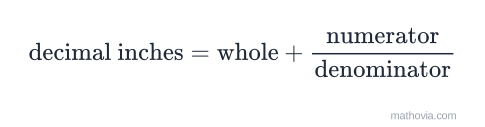
The fraction to decimal formula
For metric, multiply the decimal by 25.4 (mm) or 2.54 (cm).
Worked example
The calculator’s defaults are 3 whole inches plus 3/8.
In metric:
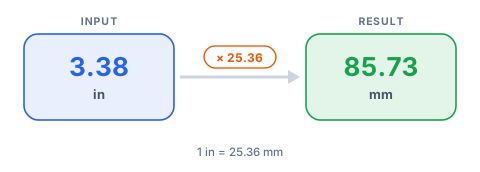
What Your Results Mean
The Decimal Inches result is the primary output you need for any calculation, CAD entry, or further conversion. The Millimeters and Centimeters results save you a separate conversion step when working with metric specifications or international suppliers.
Common fraction-to-decimal reference
| Fraction | Decimal | mm |
|---|---|---|
| 1/32 | 0.03125 | 0.794 |
| 1/16 | 0.0625 | 1.588 |
| 3/32 | 0.09375 | 2.381 |
| 1/8 | 0.125 | 3.175 |
| 5/32 | 0.15625 | 3.969 |
| 3/16 | 0.1875 | 4.763 |
| 7/32 | 0.21875 | 5.556 |
| 1/4 | 0.25 | 6.35 |
| 9/32 | 0.28125 | 7.144 |
| 5/16 | 0.3125 | 7.938 |
| 11/32 | 0.34375 | 8.731 |
| 3/8 | 0.375 | 9.525 |
| 13/32 | 0.40625 | 10.319 |
| 7/16 | 0.4375 | 11.113 |
| 15/32 | 0.46875 | 11.906 |
| 1/2 | 0.5 | 12.7 |
| 17/32 | 0.53125 | 13.494 |
| 9/16 | 0.5625 | 14.288 |
| 19/32 | 0.59375 | 15.081 |
| 5/8 | 0.625 | 15.875 |
| 21/32 | 0.65625 | 16.669 |
| 11/16 | 0.6875 | 17.463 |
| 23/32 | 0.71875 | 18.256 |
| 3/4 | 0.75 | 19.05 |
| 25/32 | 0.78125 | 19.844 |
| 13/16 | 0.8125 | 20.638 |
| 27/32 | 0.84375 | 21.431 |
| 7/8 | 0.875 | 22.225 |
| 29/32 | 0.90625 | 23.019 |
| 15/16 | 0.9375 | 23.813 |
| 31/32 | 0.96875 | 24.606 |
| 1 | 1.0 | 25.4 |
Why this matters in practice
When programming a CNC router, you enter dimensions in decimal inches (or mm). A cabinet side that’s “23 and 5/16 inches” becomes 23.3125 in your G-code. Getting this conversion wrong by even one sixteenth (0.0625”) means parts won’t fit, so precision matters.
Common mistakes
- Adding the whole number to the fraction wrong.
is , not rounded or . - Rounding the decimal too soon. Carry the full value (0.3125, not 0.31) when it feeds a cut list — a stack of small roundings adds up.
- Mixing the mm factor with cm. Multiply decimal inches by 25.4 for millimetres and 2.54 for centimetres; swapping them is off by a factor of 10.
- Reading a caliper’s decimal as a fraction directly. 0.313” is close to 5/16” (0.3125”), but not exactly — round to the nearest fraction only when a fraction is what you need.
To go the other direction and convert a decimal back to a tape-measure-friendly fraction, use the inches to fraction calculator. If you need the final value in metric only, the inches to mm converter and inches to cm converter work directly from decimal inch inputs.
A shortcut for sixteenths
Learn one number and every sixteenth follows:
The same idea works for eighths (
Fractional inches to decimal feet
Surveyors and some estimating software work in decimal feet. Convert to decimal inches first, then divide by 12. For 7 3/8 inches:
A wall that’s 10 ft 7 3/8 in long is therefore about 10.615 ft in decimal feet.