Mathovia

Electrical / Power & Wattage

Amp-Hours (Ah) to Watt-Hours (Wh) Conversion Calculator

Convert battery capacity from amp-hours to watt-hours using the battery voltage.

Energy
1,200.0 Wh
00506001001,2001501,8002002,400AhWh100 Ah1,200 Wh
Watt-hours are amp-hours multiplied by the battery voltage.

Use the stated electrical relationship and enter values in the displayed units.

Source: Formula conventions follow standard electrical engineering relationships. Verify equipment ratings and local code requirements before installation.

Written by
MPhil in Mathematics, Founder of Mathovia
Published

Mathematics verification: Mathematical formulas, calculations, worked examples and solutions are reviewed for accuracy before publication. How we check our work

Amp-Hours (Ah) to Watt-Hours (Wh) Conversion Calculator formula
The Amp-Hours (Ah) to Watt-Hours (Wh) Conversion formula

Charge in, energy out

Amp-hours is the unit on almost every deep-cycle, marine, and lithium battery label. It measures charge — how long the battery can supply one amp (100 Ah means 100 hours at 1 A, or 1 hour at 100 A). But solar panels, charge controllers, inverters, and generators are rated in watt-hours and kilowatt-hours, which measure energy. Multiplying amp-hours by the battery’s voltage bridges the two, and it’s the step that lets you check whether a battery bank can carry a day’s worth of loads.

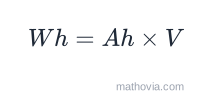
The amp-hours to watt-hours formula

is the amp-hour rating and is the nominal voltage — 12, 24, or 48 V for a system, about 3.7 V for a single lithium cell. There’s no scaling constant; watt-hours is just charge times voltage.

Worked example

The calculator’s defaults are a 100 Ah battery at 12 V.

The battery stores 1,200 watt-hours, or 1.2 kWh. To picture it: a 60 W laptop charger running for 20 hours, or a 1,200 W kettle for one hour, before losses.
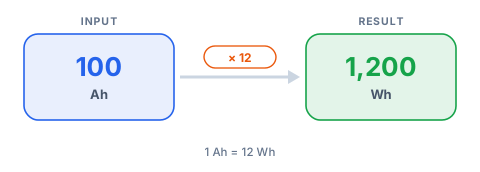
Amp-Hours (Ah) to Watt-Hours (Wh) Conversion Calculator worked example diagram
A visual read of the worked example above — the same numbers the calculator returns for its default inputs.

Amp-hours to watt-hours at common voltages

Ah12 V24 V48 V
20240 Wh480 Wh960 Wh
50600 Wh1,200 Wh2,400 Wh
1001,200 Wh2,400 Wh4,800 Wh
2002,400 Wh4,800 Wh9,600 Wh
3003,600 Wh7,200 Wh14,400 Wh

Two 100 Ah batteries in series make a 24 V, 100 Ah bank — 2,400 Wh. The same two in parallel stay 12 V but become 200 Ah — also 2,400 Wh. Series or parallel, the energy is identical; only the voltage-and-current split changes.

What limits the real figure

The amp-hour rating is measured at a slow, standardized discharge rate, often C/20 — the full capacity drained evenly over 20 hours. Pull harder than that and fewer usable amp-hours come out, an effect called Peukert’s law that hits lead-acid harder than lithium. Cold temperatures, a partial state of charge, and age pull the delivered watt-hours further below the nameplate. Treat the calculated figure as the ceiling.

Common mistakes

  • Using a charged or resting voltage instead of nominal, which inflates the result.
  • Adding series and parallel capacities the wrong way. Series adds voltage; parallel adds amp-hours; watt-hours add either way.
  • Expecting full rated Wh at a high discharge rate.

For the reverse, use the watt-hours to amp-hours calculator. For the kilowatt-hour scale, see amp-hours to kWh.

About the formula: Use the stated electrical relationship and enter values in the displayed units.

Frequently Asked Questions

How do I convert amp-hours to watt-hours?+

Multiply amp-hours by the battery's nominal voltage: Wh = Ah × V. A 100 Ah battery at 12 V holds 1,200 Wh.

Why do two 100 Ah batteries store different amounts of energy?+

Because energy depends on voltage as well as charge. A 100 Ah battery at 24 V holds 2,400 Wh — twice a 100 Ah 12 V battery — even though the amp-hour number is identical.

Should I use nominal or resting voltage?+

Nominal — the label figure, 12/24/48 V for a pack or about 3.7 V for a lithium cell. Nameplate Ah ratings are defined against nominal voltage, so a multimeter's off-the-charger reading would overstate the result.

Will the battery actually deliver its full rated watt-hours?+

Usually a little less. The Ah rating is measured at a slow discharge rate; pulling more current than that cuts usable capacity (Peukert's law), and cold temperatures and age reduce it further.

How does this help me size a solar or backup system?+

Solar panels, charge controllers, and inverters are rated in watts and watt-hours, while batteries are labeled in amp-hours. Converting Ah to Wh puts the battery on the same scale as the rest of the system so you can match daily production to storage.

Is Wh the same as VA-hours?+

No. Wh is real energy. For AC loads, apparent-power-hours (VAh) would also involve the power factor. Battery capacity is a DC quantity, so watt-hours is the right unit.