
Energy in, charge out
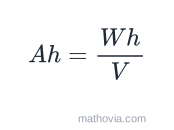
Battery specs come in two flavors. Power stations, e-bike packs, and tool batteries are often quoted in watt-hours; deep-cycle and marine batteries in amp-hours. To compare them, or to design a system where the charge controller and the cable ampacity both work in amps, you need the amp-hour figure. That means dividing the energy by the battery’s voltage.
The watt-hours to amp-hours formula
It’s the
Worked example
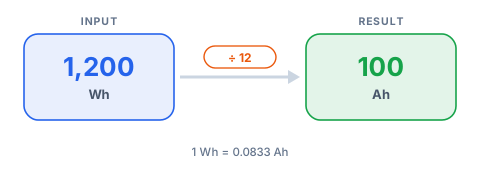
The calculator’s defaults are 1,200 Wh at 12 V.
A 1,200 Wh battery at 12 V is a 100 Ah battery. Wire the same 1,200 Wh as a 24 V pack and it becomes 50 Ah; as 48 V, 25 Ah. The energy is fixed; raising the voltage lowers the amp-hours in proportion.
Watt-hours to amp-hours at common voltages
| Wh | 12 V | 24 V | 48 V |
|---|---|---|---|
| 300 | 25 Ah | 12.5 Ah | 6.25 Ah |
| 600 | 50 Ah | 25 Ah | 12.5 Ah |
| 1,200 | 100 Ah | 50 Ah | 25 Ah |
| 2,400 | 200 Ah | 100 Ah | 50 Ah |
| 5,000 | 417 Ah | 208 Ah | 104 Ah |
Why the amp-hour figure matters for wiring
Two batteries can hold the same energy but demand very different cable. A 5 kWh bank at 12 V has to move about 417 Ah worth of current capacity; the same 5 kWh at 48 V needs only about 104 Ah. Since conductor size, fuse rating, and resistive loss all track current, the low-voltage bank needs far heavier, more expensive copper for the same job. That’s the practical reason larger off-grid systems run at 48 V.
What the result assumes
The conversion uses nominal voltage, because that’s what manufacturers pair Wh and Ah ratings against. Delivered capacity in the field runs below the rated Ah once you account for discharge rate, cold temperatures, and battery age. The number here is the nameplate value.
Common mistakes
- Using the fully-charged voltage (e.g. 13.6 V for a 12 V battery), which understates the amp-hours.
- Comparing two packs by Wh but wiring for the wrong Ah, leaving cable undersized.
- Assuming rated Ah is always available regardless of load.
For the reverse, use the amp-hours to watt-hours calculator. For small cells in milliamp-hours, see watt-hours to mAh.