
Why amp-hours don’t tell the whole story
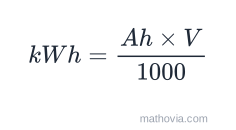
A battery label that says “100 Ah” is telling you about charge, not energy. Charge is how many electrons the battery can push out; energy is how much work those electrons can do, and that also depends on the voltage behind them. A 100 Ah battery at 12 V and a 100 Ah battery at 48 V hold the same charge but four times different energy. To compare batteries fairly, or to line a battery up against a solar array or an electricity bill — both of which are in kWh — you have to convert.
The amp-hours to kWh formula
Worked example
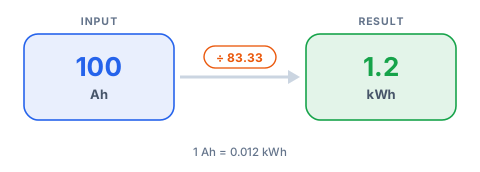
The calculator’s defaults are a 100 Ah battery at 12 V.
Energy in watt-hours:
Rescaled to kilowatt-hours:
So the battery holds 1.2 kWh of nominal energy. That’s roughly enough to run a 100 W fridge for half a day, or a 1,000 W microwave for a little over an hour — before any losses.
The same 100 Ah at different voltages
| Battery | Nominal voltage | Energy |
|---|---|---|
| 100 Ah | 12 V | 1.2 kWh |
| 100 Ah | 24 V | 2.4 kWh |
| 100 Ah | 36 V | 3.6 kWh |
| 100 Ah | 48 V | 4.8 kWh |
This is the practical case for higher-voltage battery banks: a 48 V bank stores four times the energy of a 12 V bank of the same amp-hour rating, while carrying a quarter of the current for a given load — thinner cable, smaller losses, less heat.
Nominal versus usable energy
The result is nameplate energy. What you can actually pull is less:
Depth of discharge (DoD) is how far you can safely drain the battery — around 0.8 for lead-acid, 0.9 or higher for lithium. System efficiency covers round-trip battery losses and inverter conversion, roughly 0.85 to 0.9. For the 1.2 kWh example at 0.8 DoD and 0.9 efficiency:
Plan runtime from the usable figure, not the nominal one.
Common mistakes
- Using the charging voltage (14.4 V, say) instead of the nominal 12 V, which overstates the energy.
- Treating nominal kWh as usable kWh. Apply the DoD and efficiency factors.
- Comparing two batteries by Ah alone when they’re different voltages — compare in kWh or Wh.
For the watt-hour version, use the amp-hours to watt-hours calculator. For the reverse, see kWh to amp-hours, and for runtime under a specific load, the battery runtime calculator.