
Apparent power and real power
Every AC circuit carries two kinds of power. Apparent power, in volt-amps, is voltage multiplied by current — the total electrical loading the source has to handle. Real power, in watts, is the part that actually does work: heat, light, torque. The two are equal only for a purely resistive load. Anything with a motor winding or a switch-mode power supply draws current that’s partly out of phase with the voltage, so its apparent power runs higher than its real power.
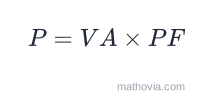
The number that connects them is the power factor. It’s the ratio of watts to VA, always between 0 and 1. Get it wrong and you undersize a circuit or overload a UPS — the classic mistake being to assume a “1000 VA” UPS can run 1,000 watts of load when many older units top out near 600 W.
The VA to watts formula
with
Worked example
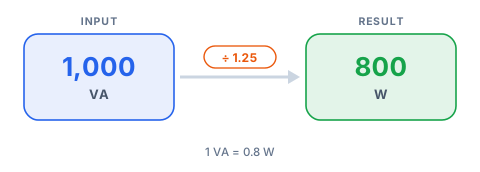
The calculator’s defaults are 1,000 VA at a power factor of 0.8.
Real power:
Reactive power:
So the load does 800 W of work while 600 VAR circulates without being consumed. Check the triangle:
VA to watts by power factor
| Apparent power | PF 1.0 | PF 0.9 | PF 0.8 | PF 0.6 |
|---|---|---|---|---|
| 500 VA | 500 W | 450 W | 400 W | 300 W |
| 1,000 VA | 1,000 W | 900 W | 800 W | 600 W |
| 1,500 VA | 1,500 W | 1,350 W | 1,200 W | 900 W |
| 3,000 VA | 3,000 W | 2,700 W | 2,400 W | 1,800 W |
Modern computer power supplies use active power-factor correction and sit near 0.95 to 1.0. Motors, older linear supplies, and lightly loaded transformers pull the figure down toward 0.6 to 0.8.
What the result means for equipment
The watts figure is the real power the load consumes and what a utility meter records. The VA figure is what the source, its wiring, and any UPS or transformer in the path must be rated to carry. Size the supply from VA; understand the actual work from watts. On a UPS spec sheet, both limits are listed separately — you can’t exceed either.
Common mistakes
- Reading a UPS’s VA rating as its watt rating. Check the watt figure too.
- Using power factor 0.8 for a resistive heater. It’s 1.0; watts equal VA.
- Treating reactive power as wasted energy. It burns no fuel, but it occupies conductor and transformer capacity the whole time it flows.
For the reverse direction, use the watts to kVA calculator. For the kilowatt scale, see VA to kW, and for current, VA to amps.