Mathovia

Electrical / Power & Wattage

Volt-amps (VA) to Amps Conversion Calculator

Calculate current from apparent power and voltage.

Current
10.00 A
001,2505.212,50010.423,75015.635,00020.83VAA2,400 VA10 A
1 VA = 0.00417 A

Use the stated electrical relationship and enter values in the displayed units.

Source: Formula conventions follow standard electrical engineering relationships. Verify equipment ratings and local code requirements before installation.

Written by
MPhil in Mathematics, Founder of Mathovia
Published

Mathematics verification: Mathematical formulas, calculations, worked examples and solutions are reviewed for accuracy before publication. How we check our work

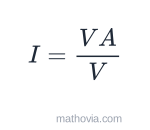
Volt-amps (VA) to Amps Conversion Calculator formula
The Volt-amps (VA) to Amps Conversion formula

Why convert VA to amps

Transformers, UPS units, and inverters carry a VA rating because that’s the quantity their windings and internal wiring have to handle. But a circuit is defined in amps — the breaker, the wire, the receptacle. To know whether a piece of VA-rated equipment fits an existing circuit, or how much current it will draw at your voltage, you divide its VA by that voltage.

Because VA is apparent power, the power factor never enters this calculation. Volts times amps is VA, so amps is simply VA divided by volts. That’s also why transformer and UPS ratings are in VA in the first place: the figure stays valid no matter what the connected load’s power factor turns out to be.

The VA to amps formula

Single-phase:

Three-phase, line-to-line voltage:

is the line current in amps, is the apparent power, and is the voltage. The √3 in the three-phase form accounts for the three line currents being 120° apart.

Worked example

The calculator’s defaults are 2,400 VA on a single-phase 240 V circuit.

The load draws 10 A. Put the same 2,400 VA on a three-phase 240 V circuit and each line carries:

less than half, because the load is spread over three conductors instead of two.

Volt-amps (VA) to Amps Conversion Calculator worked example diagram
A visual read of the worked example above — the same numbers the calculator returns for its default inputs.

VA to amps at common voltages (single-phase)

VA120 V208 V240 V277 V
5004.2 A2.4 A2.1 A1.8 A
1,0008.3 A4.8 A4.2 A3.6 A
1,50012.5 A7.2 A6.3 A5.4 A
3,00025.0 A14.4 A12.5 A10.8 A
5,00041.7 A24.0 A20.8 A18.1 A

Transformer current, both sides

A transformer’s VA is the same on the primary and the secondary, minus small losses. So the same rating gives you both currents: divide by the primary voltage for the input current, by the secondary voltage for the output current. A 1,000 VA 120/24 V control transformer draws about 8.3 A on its 120 V side and delivers about 41.7 A on its 24 V side.

What the result covers

This is the steady running current at the entered voltage. It doesn’t include the inrush a motor or transformer draws for the first cycle or two at power-up, and it assumes the supply holds at nominal voltage. For wire and breaker sizing, apply the continuous-load margin and derating rules from your local code on top of this figure.

Common mistakes

  • Forgetting √3 for three-phase, which overstates the current by about 73%.
  • Using the wrong voltage — current scales inversely with it.
  • Adding a power factor. VA to amps doesn’t use one.

For the reverse, use the amps to VA calculator. For the kilovolt-amp scale, see kVA to amps, and for real power, VA to watts.

About the formula: Use the stated electrical relationship and enter values in the displayed units.

Frequently Asked Questions

How many amps is 2400 VA at 240 volts?+

On single-phase 240 V, 2,400 ÷ 240 = 10 A. On three-phase 240 V it's 2,400 ÷ (1.732 × 240) ≈ 5.8 A per line, since the load is carried on three conductors instead of two.

How does VA to amps work?+

Apparent power is voltage times current, so current is VA divided by voltage — and by √3 as well for a three-phase circuit. Power factor doesn't enter into it because VA already includes the reactive current.

Why doesn't this calculator ask for power factor?+

VA is apparent power by definition: just volts times amps. A power-factor step would only be needed if you were starting from real power in watts, which is a different calculation.

Can I size a wire or breaker straight from this current?+

It's a starting point only. Continuous loads need a 125% margin under most codes, and the final conductor size still depends on the ampacity tables, conduit fill, and ambient temperature.

My UPS is 1500 VA. How much current does it pull at full load?+

On a 120 V circuit, 1,500 ÷ 120 = 12.5 A on the input side at full output, before accounting for the UPS's own inefficiency and any battery-charging current, which push the real input current a little higher.

Does a transformer's VA rating give its primary or secondary current?+

Either — the VA is the same on both sides (minus small losses), so divide the VA by the primary voltage for primary current, or by the secondary voltage for secondary current. A 1,000 VA 120/24 V transformer is about 8.3 A in and 41.7 A out.

Related calculators