
What this tells you
A generator or UPS rated in VA can only deliver its full apparent power into a perfectly resistive load. Connect anything with motors or electronic supplies and some of that capacity goes to reactive current that does no work. This conversion tells you how many kilowatts of real, usable power a VA rating actually yields at a given power factor — the headroom question for equipment that was sized in apparent-power terms.
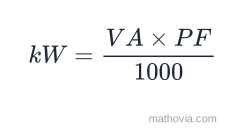
The VA to kW formula
Worked example
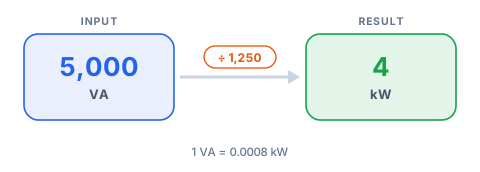
The calculator’s defaults are 5,000 VA at a power factor of 0.8.
Apply the power factor:
Rescale to kilowatts:
So a 5,000 VA source delivers 4 kW of real power into an 0.8-power-factor load. The reactive component is
VA to kW by power factor
| Apparent power | PF 1.0 | PF 0.9 | PF 0.8 | PF 0.6 |
|---|---|---|---|---|
| 1,000 VA | 1.0 kW | 0.9 kW | 0.8 kW | 0.6 kW |
| 2,500 VA | 2.5 kW | 2.25 kW | 2.0 kW | 1.5 kW |
| 5,000 VA | 5.0 kW | 4.5 kW | 4.0 kW | 3.0 kW |
| 10,000 VA | 10.0 kW | 9.0 kW | 8.0 kW | 6.0 kW |
VA, kVA and MVA
The same conversion works at any scale; only the prefix changes. 1 kVA is 1,000 VA and 1 MVA is 1,000 kVA, or 1,000,000 VA. Utility transformers and large generators are rated in MVA, so for those:
A 2.5 MVA transformer feeding a load at a 0.9 power factor delivers
Don’t re-size the supply from this
The kW figure is smaller than the VA figure, but that doesn’t mean the source has spare capacity. The reactive power the calculation strips away still occupies the generator’s alternator and the feeder conductors. Size the supply against the VA rating; use this kW result only to understand how much real work that VA can do.
Common mistakes
- Assuming unity power factor for a motor or electronics load, which overstates the usable kW.
- Sizing a generator from the kW result instead of the original VA.
- Forgetting the ÷ 1,000 and reporting watts as kilowatts.
For the watt-scale version, use the VA to watts calculator. For the reverse, see kW to VA, and for line current, VA to amps.
Reading a UPS label
Many UPS units list both ratings, for example 1,500 VA / 900 W. That implies a design power factor of
The reactive part
Apparent, real and reactive power form a right triangle:
A 5 kVA load drawing 4 kW of real power has
Why power factor matters on a bill
Some commercial tariffs charge for low power factor or for peak kVA demand. Raising the power factor with capacitor banks reduces the kVA drawn for the same kW, which can lower those charges and free up capacity on the supply.