Mathovia

Electrical / Power & Wattage

Watts to Kilovolt-Amps (kVA) Conversion Calculator

Estimate apparent power from watts and power factor.

Apparent Power
5.000 kVA
001,2501.562,5003.133,7504.695,0006.25WkVA4,000 W5 kVA
1 W = 0.00125 kVA

Use the stated electrical relationship and enter values in the displayed units.

Source: Formula conventions follow standard electrical engineering relationships. Verify equipment ratings and local code requirements before installation.

Written by
MPhil in Mathematics, Founder of Mathovia
Published

Mathematics verification: Mathematical formulas, calculations, worked examples and solutions are reviewed for accuracy before publication. How we check our work

Watts to Kilovolt-Amps (kVA) Conversion Calculator formula
The Watts to Kilovolt-Amps (kVA) Conversion formula

Turning a measured wattage into a sizing number

You’ve measured or looked up a load’s real power in watts, and now you need the apparent power in kVA — because that’s how generators, UPS units, and transformers are rated. Real power is the work the load does; apparent power is what the source has to supply once the reactive current is included. The two diverge whenever the load isn’t purely resistive, and the power factor is the ratio between them.

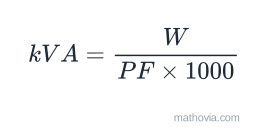
The watts to kVA formula

is real power in watts, is the power factor from 0 to 1, and the 1,000 rescales volt-amps to kilovolt-amps. Dividing by a power factor of 1 or less can only hold the number steady or increase it, so the kVA figure is always at least the wattage ÷ 1,000.

Worked example

The calculator’s defaults are 4,000 W at a power factor of 0.8.

Divide by the power factor to get volt-amps:

Rescale to kilovolt-amps:

The load consumes 4,000 W of real power but presents 5 kVA to the source. A generator or UPS for this load needs a rating of at least 5 kVA before any margin is added.
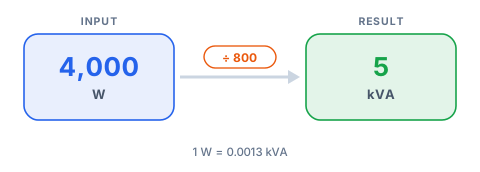
Watts to Kilovolt-Amps (kVA) Conversion Calculator worked example diagram
A visual read of the worked example above — the same numbers the calculator returns for its default inputs.

Watts to kVA by power factor

WattsPF 1.0PF 0.9PF 0.8PF 0.65
500 W0.50 kVA0.56 kVA0.63 kVA0.77 kVA
1,500 W1.50 kVA1.67 kVA1.88 kVA2.31 kVA
4,000 W4.00 kVA4.44 kVA5.00 kVA6.15 kVA
8,000 W8.00 kVA8.89 kVA10.00 kVA12.31 kVA

Getting the power factor right

For a single appliance the power factor is often a guess, and the guess drives the whole result. Many plug-in energy meters display power factor or VA directly alongside watts — use that reading when you have it. Failing that: near 1.0 for resistive heat, roughly 0.9 for power-factor-corrected electronics, 0.7 to 0.85 for motors, pumps, and older linear supplies. When several loads run together, their power factors don’t simply average; the reactive parts add separately from the real parts.

Beyond the steady-state number

The kVA figure this returns is the continuous demand. Practical sizing of a generator or UPS adds headroom for motor starting surge, for the harmonic distortion that switch-mode loads inject, and for future load growth — commonly 20 to 25% on top.

Common mistakes

  • Assuming unity power factor for anything with a motor or a cheap power supply.
  • Skipping the ÷ 1,000 and reporting VA as kVA.
  • Sizing a source exactly to the result with no margin for inrush or growth.

For the reverse, use the kVA to watts calculator. To get line current from the apparent power, see kVA to amps.

About the formula: Use the stated electrical relationship and enter values in the displayed units.

Frequently Asked Questions

How do I convert watts to kVA?+

Divide the watts by the power factor, then divide by 1,000. kVA = watts ÷ (PF × 1000). The result is apparent power in the unit generator, UPS, and transformer nameplates use.

What is 4000 watts in kVA?+

At a power factor of 0.8, 4,000 ÷ (0.8 × 1,000) = 5 kVA. At unity power factor it's 4 kVA. A source has to supply the apparent power, so a poorer power factor demands a bigger generator or transformer for the same wattage.

Why is kVA always at least as big as the wattage?+

Power factor never exceeds 1, so dividing by it can only keep a number the same or make it larger. Apparent power always covers at least the real power, plus any reactive power the load also pulls.

Can I size a generator or UPS from this kVA figure alone?+

Treat it as the steady-state baseline. Add margin for motor starting surge, for the distortion that electronic loads add, and for future growth. Sizing a source exactly to the calculated kVA leaves no room for the real world.

I measured watts with a plug-in meter. What power factor do I use?+

Many plug-in energy meters also display power factor or VA directly — use that reading. If yours only shows watts, estimate: near 1 for heaters, around 0.9 for modern electronics, 0.7 to 0.85 for motors and older supplies.

Does converting to kVA tell me the current?+

Not by itself. Once you have kVA you also need the voltage: amps = VA ÷ voltage for single-phase, or VA ÷ (√3 × voltage) for three-phase.

Related calculators