
Reading an energy log backward
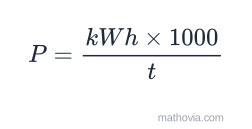
A smart plug or an appliance’s built-in meter tells you how many kilowatt-hours something used. To compare that against a nameplate wattage — or just to understand what the device was doing — you want an average power figure. Divide the energy by the hours it covered, with a factor of 1,000 to land the answer in watts rather than kilowatts.
The kWh to watts formula
Worked example
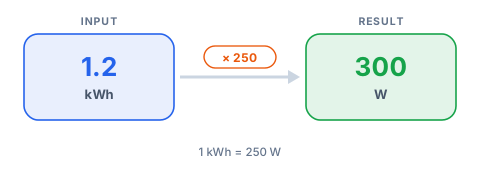
The calculator’s defaults are 1.2 kWh used over 4 hours.
Watt-hours:
Average watts:
The device averaged 300 W over those four hours. For a load that runs steadily — a game console, a small heater on low — 300 W is close to its real draw. For a load that cycles, the running wattage is higher than the average: a fridge that averages 300 W might pull 450 W while its compressor is on and near zero the rest of the time.
kWh to watts by duration
| Energy | over 1 hr | over 4 hr | over 8 hr | over 24 hr |
|---|---|---|---|---|
| 0.5 kWh | 500 W | 125 W | 63 W | 21 W |
| 1.2 kWh | 1,200 W | 300 W | 150 W | 50 W |
| 3 kWh | 3,000 W | 750 W | 375 W | 125 W |
| 10 kWh | 10,000 W | 2,500 W | 1,250 W | 417 W |
The same energy reads as a very different wattage depending on how long it took. A device logging 1.2 kWh overnight (8 hours) is a gentle 150 W load; the same 1.2 kWh in one hour is a serious 1,200 W.
What the average hides
The figure assumes the energy was drawn evenly. Most equipment doesn’t cooperate — compressors cycle, motors ramp, thermostats switch fully on and off. The average watts is the right number for estimating cost or comparing against a rating, but it isn’t what a clamp meter would read at any given second, and it isn’t the peak a circuit has to withstand.
Common mistakes
- Confusing average with instantaneous draw.
- Entering minutes as hours — convert first.
- Forgetting the ×1,000 and reporting kilowatts as watts.
For the reverse, use the watts to kWh calculator. For the kilowatt-scale version, see kWh to kW.
From a monthly bill to average watts
A 30-day month has 720 hours. A household that used 900 kWh in that month averaged:
That’s like one 1,250 W heater running around the clock. Comparing this average with your appliances’ wattages is a quick way to see where the energy goes.
Measurements in minutes
Convert minutes to hours before entering them. A kettle that used 0.15 kWh in 20 minutes:
That’s lower than a typical kettle’s 1,500–3,000 W rating, which suggests it switched off partway through the 20 minutes. When the logged average is well below the nameplate figure, the device was idle for part of the time.
Checking a nameplate rating
Running a device for a known time on a plug-in meter and dividing gives its real average draw. A TV labelled 120 W that logs 0.36 kWh over 4 hours averaged