
What amps to VA gives you
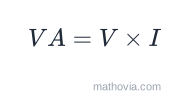
Volt-amps is apparent power — the plain product of voltage and current in an AC circuit. UPS units, power strips, isolation transformers, and control transformers are rated in VA because that’s the current-handling job they have to do, whether or not that current does useful work. If you know a load’s current, converting it to VA lets you check it against one of those ratings.
No power factor is needed. That’s the point of a VA rating: it stays valid regardless of the load’s power factor, so the manufacturer doesn’t have to guess what you’ll plug in.
The amps to VA formula
Single-phase:
Three-phase, line-to-line voltage:
Worked example
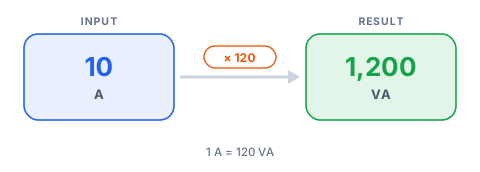
The calculator’s defaults are 10 A at 120 V, single-phase.
The load presents 1,200 VA. On a three-phase 208 V circuit, the same 10 A per line would be
Amps to VA reference (single-phase)
| Current | 120 V | 208 V | 240 V |
|---|---|---|---|
| 1 A | 120 VA | 208 VA | 240 VA |
| 5 A | 600 VA | 1,040 VA | 1,200 VA |
| 10 A | 1,200 VA | 2,080 VA | 2,400 VA |
| 15 A | 1,800 VA | 3,120 VA | 3,600 VA |
| 20 A | 2,400 VA | 4,160 VA | 4,800 VA |
Sizing a UPS or power strip
A UPS has two independent limits — a VA rating and a watt rating — and the smaller one governs. For a computer load with a power-factor-corrected supply, the watt and VA figures are close, so either can be the limit. For a load with a poorer power factor, the VA limit is reached first. Convert your load’s current to VA with this calculator, then confirm it sits under both of the UPS’s ratings.
Common mistakes
- Treating VA as watts. They match only for a resistive load; otherwise VA is higher.
- Dropping the √3 for three-phase.
- Using nominal voltage when the real supply voltage sags under load, which changes the VA proportionally.
For the reverse, use the VA to amps calculator. For the kilovolt-amp scale, see amps to kVA.