
Why convert amps to kVA
Generators, UPS units, and transformers are rated in kVA — apparent power. If you’ve measured a load’s current, or you’re planning one, converting that current to kVA lets you check it against a unit’s nameplate directly. It’s the standard way to answer “will this transformer carry that load?” or “how loaded is this generator right now?”
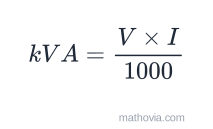
Apparent power is voltage times current, full stop. The power factor doesn’t appear, because kVA already includes the reactive current. That’s exactly the property that makes kVA the right rating for equipment: it holds true regardless of what gets plugged in.
The amps to kVA formula
Single-phase:
Three-phase, line-to-line voltage:
Worked example
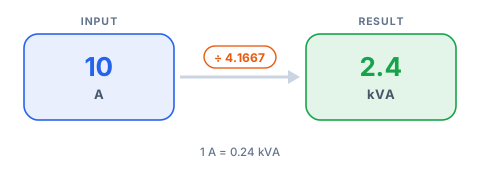
The calculator’s defaults are 10 A at 240 V, single-phase.
Volt-amps first:
Then to kilovolt-amps:
On a three-phase 240 V circuit, the same 10 A per line would be
Amps to kVA reference (single-phase)
| Current | 120 V | 208 V | 240 V | 480 V |
|---|---|---|---|---|
| 5 A | 0.6 kVA | 1.04 kVA | 1.2 kVA | 2.4 kVA |
| 10 A | 1.2 kVA | 2.08 kVA | 2.4 kVA | 4.8 kVA |
| 20 A | 2.4 kVA | 4.16 kVA | 4.8 kVA | 9.6 kVA |
| 50 A | 6.0 kVA | 10.4 kVA | 12.0 kVA | 24.0 kVA |
| 100 A | 12.0 kVA | 20.8 kVA | 24.0 kVA | 48.0 kVA |
For three-phase, multiply any figure by 1.732.
Checking transformer headroom
Convert the measured load current to kVA and compare it against the transformer’s kVA nameplate. A 15 kVA transformer carrying 9 kVA of load has 6 kVA of spare capacity. Utilities and facility engineers do this routinely to decide whether a transformer can take an added load before it needs upsizing.
Common mistakes
- Dropping the √3 for three-phase, which understates the kVA by about 42%.
- Using line-to-neutral voltage where line-to-line belongs in the three-phase formula.
- Comparing the result to a kW rating. Match kVA to kVA.
For the reverse, use the kVA to amps calculator. For real power, see amps to kilowatts.
Sizing a generator from measured current
Add up the running current of everything the generator will power, convert to kVA, then add a margin. Three loads at 240 V drawing 12 A, 8 A and 5 A:
Adding a 25% margin points to a generator of about 7.5 kVA. Motors such as pumps and compressors draw several times their running current for a moment at start-up, so if one is in the mix, check its starting current too.
From kVA to kW
kVA tells you the load on the equipment; kW tells you the real power doing work. Multiply by the power factor:
The default 2.4 kVA load at a power factor of 0.85 delivers
A three-phase example
A three-phase machine on a 400 V supply draws 32 A per line:
Leaving out the 1.732 would give 12.8 kVA, and a transformer sized from that number would be badly overloaded.