
Why convert amps to horsepower
Electrical people measure motors in amps; mechanical people rate them in horsepower. This calculation crosses between the two. It’s what you use to sanity-check a motor’s claimed horsepower against a clamp-meter reading, to identify an unlabeled motor from its running current, or to confirm a replacement’s nameplate current is plausible for the horsepower on the box.
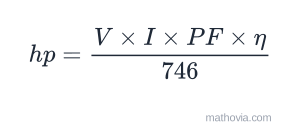
Getting from current to shaft horsepower takes four things beyond the amps: the voltage, whether the supply is single- or three-phase, the power factor, and the efficiency. The power factor converts current into real electrical power; the efficiency accounts for the losses between the terminals and the shaft.
The amps to horsepower formula
Single-phase:
Three-phase, line-to-line voltage:
Worked example
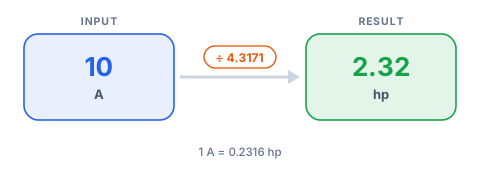
The calculator’s defaults are 10 A at 240 V, single-phase, power factor 0.8, efficiency 90%.
Real electrical power, then output:
The motor delivers about 2.32 horsepower to the shaft while drawing 1,920 W of real power from the line — the 192 W difference is lost as heat and friction inside the motor.
Rough current per horsepower
Single-phase, PF 0.8, efficiency 88%:
| Motor | 120 V | 240 V |
|---|---|---|
| 1/2 hp | ~4.4 A | ~2.2 A |
| 1 hp | ~8.8 A | ~4.4 A |
| 2 hp | ~17.7 A | ~8.8 A |
| 3 hp | ~26.5 A | ~13.2 A |
| 5 hp | ~44 A | ~22 A |
Larger motors are built with better power factor and efficiency, so their current per horsepower drops as size increases — a 50 hp motor draws proportionally less per hp than a 5 hp one.
What the result is and isn’t
It’s an estimate of shaft output horsepower under the assumed conditions. It is not a substitute for the nameplate, and it’s least accurate for a lightly loaded motor, where both power factor and efficiency fall below their rated values. For circuit design, use the nameplate full-load amps and the applicable code table, which carry safety margins this calculation doesn’t.
Common mistakes
- Wrong system type — single-phase selected for a three-phase motor overstates the horsepower by about 73%.
- Assuming power factor 1, which a resistive heater has but a motor never does.
- Using efficiency as a multiplier on the current rather than on the power.
For the reverse, use the horsepower to amps calculator. For apparent power, see horsepower to kVA.
Why voltage changes the current
The same horsepower needs less current at a higher voltage, because power is voltage times current. Typical full-load currents from the US National Electrical Code tables show it clearly for a 5 hp motor:
- Single-phase at 230 V: about 28 A.
- Three-phase at 460 V: about 7.6 A.
The three-phase motor at double the voltage draws less than a third of the current. That’s why large motors run on three-phase, higher-voltage supplies: smaller wires and breakers carry the same power.
Horsepower to kilowatts
One horsepower is about 0.746 kW. A 5 hp motor delivers about 3.73 kW at the shaft. Because no motor is 100% efficient, it draws more than that from the supply. At 85% efficiency, about
Using a clamp meter reading
A clamp meter on a running motor gives the actual current, which is usually below the nameplate full-load amps unless the motor is fully loaded. Converting that reading tells you roughly how hard the motor is working. A reading well below nameplate on a pump that’s struggling can point to a mechanical problem rather than an electrical one.