
A proportion states that two fractions are equal — a/b = c/d. Know any three of the four numbers and the fourth is determined. This is the hidden structure behind scaling a recipe, converting units, reading a map, and solving similar triangles: “if 2 cups makes 3 servings, how many cups make 6 servings?” is exactly a/b = c/d with one blank.
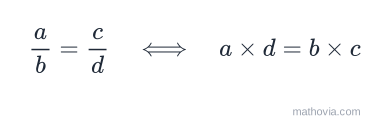
The cross-multiplication identity
Solving that single equation for whichever term is unknown gives four rearrangements:
Worked example
The calculator’s default solves for the first numerator with b = 3, c = 4, d = 6.
So 2/3 = 4/6 — the proportion checks out.
How to Solve for an Unknown Fraction Value (step by step)
Every version below starts from the same cross-multiplied equation: a × d = b × c. Which letter you solve for just depends on which one is missing.
Solve First Numerator (a)
Given b, c, and d, solve a/b = c/d for a.
a = (b × c) ÷ d
With b = 3, c = 4, d = 6:
a = (3 × 4) ÷ 6 = 2
2/3 = 4/6 ✓
Solve First Denominator (b)
Given a, c, and d, solve a/b = c/d for b.
b = (a × d) ÷ c
With a = 2, c = 4, d = 6:
b = (2 × 6) ÷ 4 = 3
2/3 = 4/6 ✓
Solve Second Numerator (c)
Given a, b, and d, solve a/b = c/d for c.
c = (d × a) ÷ b
With a = 2, b = 3, d = 6:
c = (6 × 2) ÷ 3 = 4
2/3 = 4/6 ✓
Solve Second Denominator (d)
Given a, b, and c, solve a/b = c/d for d.
d = (c × b) ÷ a
With a = 2, b = 3, c = 4:
d = (4 × 3) ÷ 2 = 6
2/3 = 4/6 ✓
What your results mean
Whichever value you solved for completes the proportion so both fractions are exactly equal. Because the underlying relationship is the same equation solved four different ways, plugging your answer back into the original fraction and cross-multiplying should always confirm both sides match — that’s a quick way to check your work by hand.
Results aren’t always whole numbers. If your three known values don’t divide evenly, the missing value will be a decimal — which is still the correct, exact answer, just not a “clean” one.
A real example: scaling a recipe
If 2 cups of flour makes 3 servings, how many cups make 6 servings? That’s the proportion 2/3 = c/6, solving for the second numerator:
c = (6 × 2) ÷ 3 = 4 cups
Where this comes up
Unit conversions, recipe scaling, map scales, and similar-triangle geometry problems are all proportions in disguise. If you already know all four fraction values and just want to check whether they’re truly proportional, use the comparing fractions calculator on the cross-multiplied pair instead. For generating a scaled-up version of a single known fraction, see the equivalent fractions calculator.
Map scales
A map uses 1 cm for 25 km. Two towns are 7.4 cm apart on the map. Set up the proportion with the same units on top and bottom of each fraction:
Similar triangles and shadows
At the same moment, a 1.8 m person casts a 2.4 m shadow and a tree casts a 16 m shadow. The sun makes similar triangles, so heights and shadows are in proportion:
When a proportion is the wrong model
Proportions assume that doubling one quantity doubles the other. Some situations work the opposite way. If 4 workers take 6 days to finish a job, 8 workers take about 3 days, not 12. That’s an inverse relationship: the product
Common mistakes
- Mismatched layout. If the first fraction is cups over servings, the second must also be cups over servings. Writing
for the recipe example gives 9 cups instead of 4. - Multiplying along the wrong diagonal. Cross-multiply top-left with bottom-right and bottom-left with top-right.
- Mixed units. Convert 1 m and 50 cm to the same unit before putting them in a proportion.
- Adding instead of scaling. Going from 3 servings to 6 servings means doubling, not adding 3 cups.