
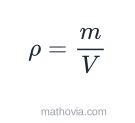
What density tells you
Density is how much mass is crammed into a given space. Two objects can be identical in size and appearance, but the heavier one is denser — that’s why a solid steel ball sinks and a foam ball of the same size floats. Because most pure substances have a stable, well-documented density under ordinary conditions, a measured density is one of the quickest ways to identify an unknown material or check the purity of a known one.
This calculator solves the density relationship in whichever direction you need: density from mass and volume, mass from density and volume, or volume from mass and density. Pick the mode that matches what you already know.
The density formula
Worked examples
Solving for density. The calculator’s defaults are a mass of 500 g and a volume of 200 cm³.
Solving for mass. Given
Solving for volume. Given
All three are the same physical situation seen from different sides.
Densities of common materials
| Material | Density (g/cm³) | Density (kg/m³) | Floats in water? |
|---|---|---|---|
| Balsa wood | 0.16 | 160 | yes |
| Ice | 0.92 | 920 | yes (just) |
| Water | 1.00 | 1,000 | — |
| Glass | 2.5 | 2,500 | no |
| Aluminium | 2.70 | 2,700 | no |
| Steel | 7.85 | 7,850 | no |
| Copper | 8.96 | 8,960 | no |
| Lead | 11.34 | 11,340 | no |
| Gold | 19.32 | 19,320 | no |
The calculated 2.5 g/cm³ from the worked example matches glass — a plausible identification for a clear, hard, non-magnetic sample.
Where density calculations are used
- Material identification. Weigh a sample, measure its volume by displacement, divide, and compare to a table.
- Buoyancy. Whether an object or a boat floats comes down to its average density versus the fluid’s.
- Unit and recipe conversions. Turning a volume of a liquid into a mass (or vice versa) needs its density — the reason “a cup of flour” and “120 g of flour” aren’t automatically the same.
- Purity checks. A metal’s measured density drifts from the pure value if it’s an alloy or contains voids.
- Shipping and packing. Freight is often priced on density (mass per volume) rather than either alone.
Common mistakes
- Mismatched units — mass in kilograms with volume in cubic centimetres gives a number 1,000× too large unless the tool normalizes for you.
- Measuring the wrong volume — for an irregular solid, use displacement, not length × width × height.
- Assuming a hollow or porous object has its material’s density. Average density includes the air inside.
For turning a density into a weight for a known volume, the mass mode above does it directly; for material-specific work like solutions, see the molarity calculator.
Finding volume by displacement
Irregular objects don’t have a length × width × height. Drop the object into a measuring cylinder of water and read the rise. A 250 g rock raises the water level from 150 mL to 245 mL:
That falls in the range for granite and other common rocks. One millilitre is exactly one cubic centimetre, so the cylinder reading converts directly.
Converting density units
- 1 g/cm³ = 1,000 kg/m³ (water is about 1,000 kg/m³).
- 1 g/cm³ ≈ 62.4 lb/ft³.
- 1 g/mL = 1 g/cm³ = 1 kg/L.
So the 2.5 g/cm³ glass from the worked example is 2,500 kg/m³, or about 156 lb/ft³.
How much of a floating object is underwater
A floating object sinks until it pushes aside its own weight of fluid. The fraction underwater equals the object’s density divided by the fluid’s density. Ice at 0.917 g/cm³ in fresh water floats about 92% submerged. In seawater (about 1.025 g/cm³) the figure is about