
Millimetres to inches is the conversion that keeps imperial tooling working with metric parts. Bearings, fasteners, electronic components, drill sizes, and 3D-printer nozzles are all specified in millimetres, but if your calipers, drill index, and tap set are imperial you need the inch equivalent — and often the nearest standard fraction, not just a decimal. The division by 25.4 is exact; the rounding to a usable fraction is where judgement comes in.
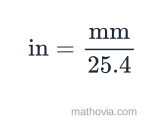
The mm to inches formula
To snap to a fractional size, multiply by the denominator you want and round:
Worked example
The calculator’s default is 150 mm.
To the nearest sixteenth:
To the nearest thirty-second:
The 1/32 value is within a thousandth of an inch of the true figure — close enough for almost anything short of precision machining.
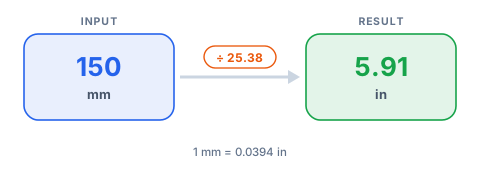
What Your Results Mean
The Inches (decimal) result is your precise conversion with six decimal places for CNC programming and calculations. The Nearest 1/16 inch and Nearest 1/32 inch results show the closest standard fractional sizes, which is what you’d actually select from a drill index or measure on a ruler.
Understanding precision loss
Converting mm to fractional inches always introduces some rounding. The maximum error for each precision level:
- 16ths: +/-0.794 mm (+/-1/32 inch)
- 32nds: +/-0.397 mm (+/-1/64 inch)
- 64ths: +/-0.198 mm (+/-1/128 inch)
For precision machining where you need better than +/-0.01”, use the decimal inch value directly rather than rounding to a fraction.
Common Metric-to-Imperial Hardware References
| Metric (mm) | Decimal inches | Nearest fraction |
|---|---|---|
| 1 | 0.0394 | 1/32 |
| 2 | 0.0787 | 5/64 |
| 3 | 0.1181 | 1/8 |
| 4 | 0.1575 | 5/32 |
| 5 | 0.1969 | 13/64 |
| 6 | 0.2362 | 15/64 |
| 7 | 0.2756 | 9/32 |
| 8 | 0.3150 | 5/16 |
| 9 | 0.3543 | 23/64 |
| 10 | 0.3937 | 25/64 |
| 11 | 0.4331 | 7/16 |
| 12 | 0.4724 | 15/32 |
| 13 | 0.5118 | 33/64 |
| 14 | 0.5512 | 9/16 |
| 15 | 0.5906 | 19/32 |
| 16 | 0.6299 | 5/8 |
| 17 | 0.6693 | 43/64 |
| 18 | 0.7087 | 23/32 |
| 19 | 0.7480 | 3/4 |
| 20 | 0.7874 | 25/32 |
| 22 | 0.8661 | 7/8 |
| 24 | 0.9449 | 15/16 |
| 25 | 0.9843 | 1 |
| 30 | 1.1811 | 1 3/16 |
| 32 | 1.2598 | 1 1/4 |
| 35 | 1.3780 | 1 3/8 |
| 38 | 1.4961 | 1 1/2 |
| 40 | 1.5748 | 1 9/16 |
| 45 | 1.7717 | 1 3/4 |
| 50 | 1.9685 | 2 |
| 60 | 2.3622 | 2 3/8 |
| 65 | 2.5591 | 2 9/16 |
| 70 | 2.7559 | 2 3/4 |
| 75 | 2.9528 | 2 15/16 |
| 80 | 3.1496 | 3 5/32 |
| 90 | 3.5433 | 3 17/32 |
| 100 | 3.9370 | 3 15/16 |
For the reverse conversion (imperial to metric), use the inches to mm converter. If you’re starting with a fractional inch measurement and need to compare it to a metric spec, the inches fraction to decimal calculator gives you the decimal inch first. For larger measurements, the meters to inches converter may be more appropriate.
Quick estimates in your head
25 mm is close to 1 inch, so dividing by 25 gives a fast estimate that’s about 1.6% too high. 100 mm is a little under 4 inches (3.94), and 300 mm is a little under a foot (11.81 inches). For a rough check of a calculated answer, that’s usually enough.
| Millimetres | Exact inches | Quick estimate |
|---|---|---|
| 5 mm | 0.197 in | about 3/16 in |
| 25 mm | 0.984 in | about 1 in |
| 50 mm | 1.969 in | about 2 in |
| 100 mm | 3.937 in | about 4 in |
| 300 mm | 11.811 in | about 1 ft |
Square millimetres to square inches
For area, the factor is squared:
Dividing by 25.4 instead would give about 157, which is wildly wrong.
Common mistakes
- Dividing by 2.54. That factor is for centimetres. 150 mm divided by 2.54 gives 59, which is ten times too big.
- Multiplying instead of dividing. Inches are bigger than millimetres, so the inch number must come out smaller.
- Treating the nearest fraction as exact. 10 mm is about 0.394 inch. The nearest sixteenth,
, is 0.375, which is close but loose for a press fit. - Reading cm on a drawing as mm. Check the title block. Engineering drawings are almost always in millimetres, while many product listings use centimetres.