
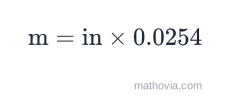
Inches to metres is the conversion for when an imperial length has to enter a metric world — a height on a passport form, US-sourced material for a project drawn in SI units, dimensions for international shipping, or a figure going into software that only accepts metres. The factor is exact: one inch is defined as 0.0254 metres.
The inches to metres formula
The 0.0254 comes from 2.54 cm per inch divided by 100 cm per metre. For centimetres, multiply by 2.54; for feet, divide the inches by 12.
Worked example
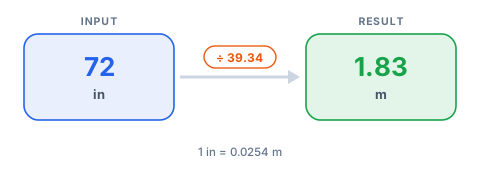
The calculator’s default is 72 inches.
72 inches is 6 feet, so 1.8288 m — rounded to 1.83 m in conversation — is the metric height of a six-footer. Cross-checking through centimetres:
What Your Results Mean
The Meters result is your SI-standard conversion with four decimal places. The Centimeters result provides the same measurement in a unit that’s often easier to visualize for body measurements or smaller objects. The Feet result is included for quick reference when comparing the original inches to the more familiar feet unit.
Height conversions people commonly need
- 36 inches (3’0”) = 0.9144 m
- 42 inches (3’6”) = 1.0668 m
- 48 inches (4’0”) = 1.2192 m
- 54 inches (4’6”) = 1.3716 m
- 60 inches (5’0”) = 1.5240 m
- 61 inches (5’1”) = 1.5494 m
- 62 inches (5’2”) = 1.5748 m
- 63 inches (5’3”) = 1.6002 m
- 64 inches (5’4”) = 1.6256 m
- 65 inches (5’5”) = 1.6510 m
- 66 inches (5’6”) = 1.6764 m
- 67 inches (5’7”) = 1.7018 m
- 68 inches (5’8”) = 1.7272 m
- 69 inches (5’9”) = 1.7526 m
- 70 inches (5’10”) = 1.7780 m
- 71 inches (5’11”) = 1.8034 m
- 72 inches (6’0”) = 1.8288 m
- 73 inches (6’1”) = 1.8542 m
- 74 inches (6’2”) = 1.8796 m
- 75 inches (6’3”) = 1.9050 m
- 76 inches (6’4”) = 1.9304 m
- 77 inches (6’5”) = 1.9558 m
- 78 inches (6’6”) = 1.9812 m
- 79 inches (6’7”) = 2.0066 m
- 80 inches (6’8”) = 2.0320 m
- 81 inches (6’9”) = 2.0574 m
- 82 inches (6’10”) = 2.0828 m
- 83 inches (6’11”) = 2.1082 m
- 84 inches (7’0”) = 2.1336 m
- 90 inches (7’6”) = 2.2860 m
- 96 inches (8’0”) = 2.4384 m
- 108 inches (9’0”) = 2.7432 m
- 120 inches (10’0”) = 3.0480 m
When meters vs. centimeters matter
Scientific papers, international shipping dimensions, and building codes outside the US all expect meters. Athletic events (high jump at 2.00 m, not 200 cm), room ceiling heights (2.4 m standard), and doorway clearances (2.03 m) are all conventionally stated in meters.
If you’re working with smaller measurements where centimeters or millimeters are more practical, use the inches to cm converter or the inches to mm converter. For converting the other way, the meters to inches calculator reverses this conversion. If your starting measurement is in feet rather than inches, convert with the feet to inches tool first.
Going from metres back to feet and inches
Heights on international forms often come in metres. Divide by 0.0254 to get inches, then split off the feet. For 1.75 m:
So 1.75 m is about 5 ft 8.9 in, which most people would round to 5’9”.
A quick estimate
One metre is about 39.37 inches, a little over a yard. For a rough answer, divide the inches by 40: 80 inches is about 2 m (the exact answer is 2.032 m). The estimate runs about 1.6% low, which is fine for a sanity check but not for a cut list.
Common mistakes
- Stopping at 2.54. Multiplying by 2.54 gives centimetres. 72 inches is 182.88 cm, which is 1.8288 m, not 182.88 m.
- Reading 5’10” as 5.10 feet. Convert to inches first:
inches, then m. - Rounding the factor to 0.025. For 72 inches that gives 1.80 m instead of 1.83 m, an error of about 3 cm.
- Square inches to square metres with the same factor. Area needs
.