
Every tape measure uses the same repeating pattern between each inch, and once it clicks, you stop counting lines one by one.
Tape measure markings: the pattern between every inch
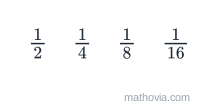
Between two whole-inch marks, a standard tape measure divides the space into halves, quarters, eighths, and sixteenths — each smaller division marked with a shorter line:
- The longest line at the midpoint is the 1/2” mark.
- The next-longest lines on either side of it are the 1/4” marks.
- Shorter lines between those are the 1/8” marks.
- The shortest lines of all are the 1/16” marks.
Line length tells you the fraction before you even count — a habit that saves real time once it’s automatic. Some tapes add an even shorter set of lines for 1/32” over the first few inches; those are for layout work, not general measuring.
Tape measure marks at a glance
Every mark between two inch numbers is one of five lengths. This is the whole system:
| Line length | Fraction | Sixteenths from the inch | How many per inch |
|---|---|---|---|
| Longest | 1/2” | 8 | 1 |
| Second longest | 1/4” and 3/4” | 4, 12 | 2 |
| Medium | 1/8”, 3/8”, 5/8”, 7/8” | 2, 6, 10, 14 | 4 |
| Shortest | odd sixteenths | 1, 3, 5, 7, 9, 11, 13, 15 | 8 |
| Extra-short (some tapes) | thirty-seconds | — | 16 |
Sixteen sixteenth-marks fill one inch, so the count in the third column is the fastest way to name any tape measure reading: count sixteenths from the last inch, put that number over 16, and simplify. Six marks past the 4” is 6/16 = 3/8, so the reading is 4-3/8”.
A faster way to read tape measure lines
Instead of counting from zero every time, anchor on the nearest big mark. If you’re near the 1/2” line, count outward in sixteenths from there rather than from the last whole inch. Most people misread tapes not because they can’t do the math, but because they start counting from the wrong anchor point.
Reading the whole number and the fraction together
A full measurement is the last whole inch you passed, plus the fraction mark the blade or pencil line lands on. If the end of your board sits three small ticks past the 5” mark, that’s 5” + 3/16” = 5 3/16”. If it’s one tick before the 6” mark, count back: 6” − 1/16” = 5 15/16”. Reading backward from the next whole inch is often faster than counting fifteen ticks forward.
What the black diamonds and red numbers mean
Two extra markings show up on most tapes and confuse people the first time:
- Red numbers or black boxes every 16 inches mark standard wall-stud and joist spacing (16” on center). They save you from doing the multiplication while laying out framing.
- Small black diamonds roughly every 19.2 inches mark the spacing for five equally spaced members (joists, trusses) across an 8-foot sheet. If you’re not framing to that spec, you can ignore them.
How to read a measuring tape in inches or centimetres
Plenty of tapes carry two scales, and mixing them up is the single most expensive mistake on this list — a cut made to a centimetre reading on an inch drawing is scrap.
- The imperial row is numbered 1, 2, 3… in inches, usually along the top edge, with the fraction marks described above. Big numbers every 12” mark the feet, often written as
1F,2For1'. - The metric row is numbered in centimetres, and every centimetre is divided into ten equal millimetre lines. There is no halving pattern and no fractions — the lines are all the same length apart from a slightly longer half-centimetre mark on some tapes.
That difference is the quickest way to tell the rows apart at a glance: if the lines vary in length, you are reading inches; if they are evenly spaced, you are reading a metric tape. A metric reading is written as a decimal — 4 lines past the 23 cm mark is 23.4 cm — where the imperial side gives you a fraction.
If you have measured in one system and need the other, the inches to centimetres converter handles the conversion, and the inch fraction calculator turns an awkward decimal back into the nearest sixteenth your tape can actually show.
A quick self-check
Common trouble spots:
- Confusing 1/8” and 3/16” lines — remember 1/8” lines are slightly longer than 3/16” lines.
- Losing count past the halfway point — re-anchor on the 1/2” mark and count backward from the next whole inch instead of forward from zero.
- Metric tapes — many tapes show both inches and centimeters; make sure you’re reading the correct row before marking a cut.
- The moving end hook — the metal tab at the tip slides about 1/16” on purpose, so it reads correctly whether you hook it over an edge or butt it against a surface. It’s not broken.
When you need to combine or convert readings
If you’re not sure whether to round up or down to the nearest 1/16” or 1/32”, our Inch Fraction Calculator will do that rounding for you and show the exact fraction your tape displays. It also adds and subtracts measurements — handy for stacking a few reads without converting to decimals in your head. For the arithmetic behind that, see how to add fractions in inches and subtracting fractions of an inch.
Once the pattern is memorized, reading a tape becomes a glance, not a count.