
Gravel is priced and delivered by the ton, but a project is laid out by area and depth. Bridging the two — area × depth for volume, volume × density for weight — is what keeps you from ordering half a load short or paying to haul away a leftover pile. This calculator also folds in an optional cost estimate if you enter a price per ton.
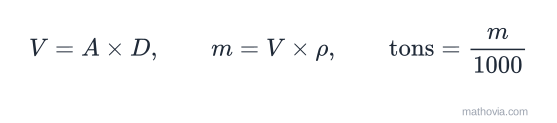
The gravel tonnage formula
Worked example
The calculator’s defaults are 200 m² at 3 cm deep, standard gravel at 1,680 kg/m³.
Add 5–10% for settling and spreading loss, so order about 10.6 to 11.1 tons.
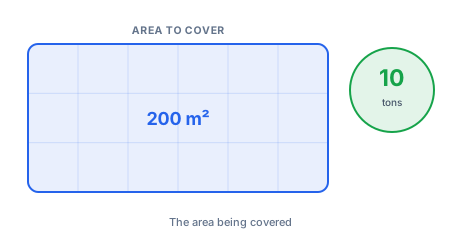
How far a load goes
| Depth | Area 10 tons of standard gravel covers |
|---|---|
| 2 cm | ~298 m² |
| 3 cm | ~198 m² |
| 5 cm | ~119 m² |
| 10 cm | ~60 m² |
How to Calculate Gravel in Tons (step by step)
Step One: Convert the area to square meters
The calculator first converts the selected area into square meters. If your area is already in square meters, the conversion factor is one.
Area in square meters = entered area × area conversion factor

200 m² = 200 × 1 = 200 m²
Step Two: Convert the depth to meters
Depth must use the same base length system as the area calculation. For the default centimeter setting, multiply the entered depth by 0.01.
Depth in meters = entered depth × depth conversion factor

3 cm = 3 × 0.01 = 0.03 m
Step Three: Calculate gravel volume
Multiply the converted area by the converted depth. This produces the amount of space the gravel must fill.
Volume = area × depth

Volume = 200 × 0.03 = 6 m³
Step Four: Estimate gravel weight
The calculator multiplies volume by the selected bulk density. The default gravel density is 1,680 kilograms per cubic meter.
Weight = volume × gravel density

Weight = 6 × 1,680 = 10,080 kg
Step Five: Convert kilograms to tons
There are 1,000 kilograms in a metric ton, so divide the estimated weight by 1,000.
Gravel needed in tons = weight in kilograms ÷ 1,000

Gravel needed = 10,080 ÷ 1,000 = 10.08 tons
Step Six: Estimate the material cost
If you enter a price per ton, the calculator multiplies that price by the estimated tonnage. The default price is zero, so the default cost estimate is zero dollars.
Estimated cost = gravel needed in tons × price per ton

Estimated cost = 10.08 × $0 = $0
What your results mean
The primary result is the estimated amount of gravel to order in tons. For the default inputs, the project needs 10.08 tons of the selected gravel type, filling 6 m³ and weighing approximately 10,080 kg.
The estimate depends heavily on depth and density. A small increase in depth increases the required volume directly, while a denser gravel type increases the tonnage without changing the space being filled. For real projects, compare the result with your supplier’s stated bulk density and delivery minimums.
Ordering tip
Consider adding 5% to 10% for settling, uneven subgrade, and handling waste. For the default result, that means planning for approximately 10.58 to 11.09 tons after applying the allowance.