Mathovia

Construction

Lumber Shrinkage Calculator

Wood moves across the grain as it gains or loses moisture. Enter a board's current width, its species, and the moisture content you're drying to, and this calculator predicts the finished width and total movement.

Width change (shrinkage)
0.162 in
Final board width
5.338 in
Change as a percentage of width
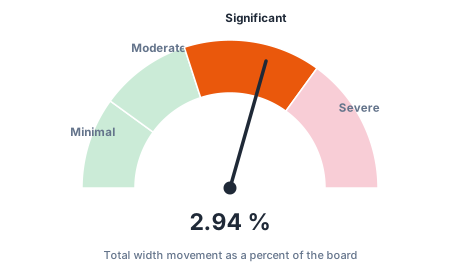
2.94 %
Movement rating
Significant - design for movement, don't glue wide panels rigidly
MinimalModerateSignificantSevere2.94 %
Total width movement as a percent of the board. Past about 2% you need to design the joint for it rather than glue it solid.

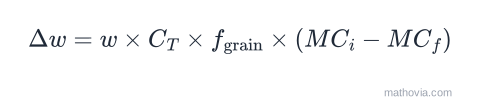
Width change equals the board's width times the species dimensional change coefficient times the change in moisture content (in percentage points). Quartersawn stock is treated as roughly 60% of the flatsawn (tangential) rate, since radial shrinkage is typically about half to two-thirds of tangential.

Source: Dimensional change coefficients from the USDA Forest Service Wood Handbook (FPL-GTR-282), Chapter 4 and Chapter 13, Table of dimensional change coefficients for common domestic species.

Written by
MPhil in Mathematics, Founder of Mathovia
Published

Mathematics verification: Mathematical formulas, calculations, worked examples and solutions are reviewed for accuracy before publication. How we check our work

Wood is hygroscopic: it takes on and gives off water vapor until it reaches equilibrium with the air around it, and it changes size as it does. That is why a deck board laid tight in spring gaps in August, why a tabletop glued up from 15% lumber cracks after a winter of forced-air heat, and why cabinet doors bind in July. Predicting the movement before you cut is the difference between a joint that lasts and one that opens up. This calculator turns species, grain orientation, and a moisture content change into an actual number in inches.
Lumber Shrinkage Calculator formula
The Lumber Shrinkage formula

The lumber shrinkage formula

is the current width across the grain, is the species’ tangential dimensional-change coefficient (the fraction of width lost per percentage point of moisture change), is 1 for flatsawn and about 0.6 for quartersawn, and is the drop in moisture content in percentage points (initial minus final). The final width is , and the change as a percentage is .

Worked example

The calculator’s defaults are a 5.5-inch flatsawn coast Douglas-fir board () drying from 19% to 8% moisture.

Fine for one board — but glue six into a 33-inch panel and that’s nearly an inch of total movement, enough to split the panel if it’s fastened rigidly on both edges.
Lumber Shrinkage Calculator worked example diagram
A visual read of the worked example above — the same numbers the calculator returns for its default inputs.

What your results mean

A 5.5-inch flatsawn Douglas-fir board drying from 19% to 8% loses 0.162 in of width and ends up 5.338 in wide, a 2.94% change. That earns a “significant” movement rating: fine for a single board, but glue six of them into a 33-inch panel and you are looking at nearly an inch of total movement, which will split the panel if it is fastened rigidly at both edges.

If the target moisture content is higher than the starting value, the result comes back negative. That is swelling, not shrinkage, and it matters just as much: kiln-dried 7% trim installed outdoors in a humid climate will grow.

Practical adjustments

  • Acclimate first. Stack lumber in the space for one to two weeks before cutting so the wood does most of its moving before you build.
  • Buy quartersawn for wide parts. Switching the same board to quartersawn cuts the movement to about 0.097 in.
  • Species matters more than people expect. Red oak at 0.00369 moves roughly 74% more than eastern white pine at 0.00212 over the same moisture swing.
  • Measure, don’t guess. A pin or pinless moisture meter costs less than one ruined panel, and “kiln-dried” at the yard can still mean 12-15% after outdoor storage.

Design for movement, don’t fight it

Frame-and-panel construction, breadboard ends with elongated screw slots, floating tabletop fasteners, and shiplap gaps all exist for one reason: they let the wood do this math without tearing itself apart.

About the formula: Width change equals the board's width times the species dimensional change coefficient times the change in moisture content (in percentage points). Quartersawn stock is treated as roughly 60% of the flatsawn (tangential) rate, since radial shrinkage is typically about half to two-thirds of tangential.

Frequently Asked Questions

How much does a 5.5-inch board shrink from 19% to 8% moisture?+

For flatsawn coast Douglas-fir: 5.5 × 0.00267 × 11 ≈ 0.16 inch, ending near 5.34 inches — about a 2.9% change across the face.

Does wood shrink while it's still soaking wet?+

No. It only moves below the fiber saturation point, around 28% moisture, where water leaves the cell walls. Drying green lumber from 60% to 30% barely moves; all the action is in the last stretch.

Why does the calculator ask only for width, not thickness or length?+

Cross-grain movement dominates and shows up as failed joints and cupped panels. Lengthwise shrinkage is only about 0.1–0.2% total and is safely ignored in normal work. Thickness moves at the same rate as width for the same grain orientation.

What moisture content should I dry to?+

The in-service average: roughly 8% for heated interiors, 6% in the arid Southwest, 11–12% for coastal or humid outdoor work.

Does quartersawn wood move less than flatsawn?+

Yes, roughly 40% less across the face, because radial shrinkage is about half to two-thirds of tangential. That's why wide tabletops and flooring are often specified quartersawn.

Which species moves the most?+

Among common domestic woods, the oaks and hard maple are high (0.0035–0.0037 per point of MC); the soft pines and cedars are low (0.0021–0.0023). Red oak moves about 75% more than eastern white pine over the same moisture swing.

Related calculators