
Concrete is specified by its compressive strength, and that number only becomes real when a lab crushes a cured specimen and records the load at failure. Turning that raw load into psi is what tells you whether the slab can be loaded, whether forms can be stripped, and whether the mix that showed up on site is the mix you paid for. Getting the arithmetic right matters because a single misplaced area value can make a passing pour look like a failure.
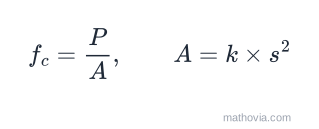
The concrete compressive strength formula
Worked example
The calculator’s defaults are an 85,000 lbf failure load on a 6-inch cylinder, against a 3,000 psi design strength.
Loaded area:
Compressive strength:
In metric and as a fraction of design:
A clean pass, with essentially no margin.
What your results mean
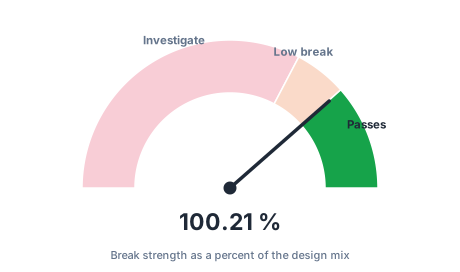
With the defaults, a 6-inch cylinder failing at 85,000 lbf yields 3,006 psi (20.73 MPa), which is 100.2% of a 3,000 psi design mix: a clean pass with essentially no margin to spare. The area figure is worth a glance too, because it is the single value most often entered wrong; if it does not read close to 28.27 in² for a standard 6×12 cylinder, the specimen size or unit is off.
Acceptance is judged on averages, not one break. Most specifications treat a mix as compliant when the average of three consecutive strength tests meets f’c and no single test falls more than 500 psi below it for mixes at or under 5,000 psi. A result landing between 85% and 100% of design is common and rarely alarming on its own; anything under 85% points at a real problem in batching, water added on site, curing temperature, or the specimen itself.
Common failure causes worth checking first
| Symptom | Likely cause |
|---|---|
| One cylinder low, others fine | Poorly consolidated or damaged specimen |
| All cylinders low | Extra water added on site or wrong mix delivered |
| Low breaks in cold weather | Specimens not kept in the 60-80°F cure range |
| Odd fracture pattern | Unlevel end surfaces or misaligned platens |
Practical tips
Always cast at least two cylinders per test age so a single bad specimen cannot condemn a pour. Log the break age alongside the psi value, since a 7-day and a 28-day result are not interchangeable evidence. And if the concrete is already in place and a 28-day break fails, core testing per ASTM C42 is the accepted next step before anyone talks about removal.
Testing 4-inch cylinders
Smaller 4 × 8-inch cylinders are common because they’re lighter and need less load to break. Their area is much smaller:
A 4-inch cylinder that fails at 40,000 lbf has a strength of
Converting a metric specification
Specs outside the US give strength in MPa. Multiply by 145.04 to get psi: a 25 MPa mix is about
Common mistakes
- Using the radius as the size. The calculator expects the diameter; the shape factor
already accounts for halving it. - Mixing load units. A load in kN or kgf entered as pounds gives a strength that is badly wrong.
- Judging a 7-day break against the 28-day target. Concrete is still gaining strength at 7 days, so an early break is usually well below the design value.
- Ignoring how the cylinder broke. A specimen with uneven ends or poor capping can fail early. The lab report’s fracture type helps tell a bad specimen from bad concrete.