
Even gaps across a deck look simple until you find that whole boards never divide cleanly into the frame width. Too wide and it reads as sloppy; too tight and it traps debris and moisture against the board edges. This calculator does the layout so every gap comes out identical and you don’t have to rip the last board to a sliver.

The deck board spacing formulas
Worked example
The calculator’s defaults are a 144-inch (12-foot) width, 5.5-inch boards, and a 0.25-inch target gap.
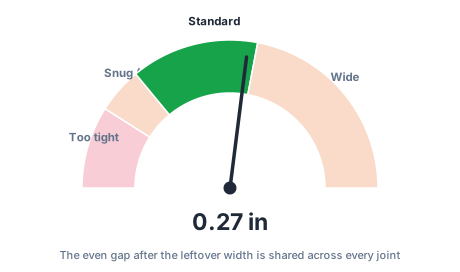
So use a 0.27-inch spacer, not a 0.25 — the difference is what keeps the last board full width.
What Your Results Mean
Boards Needed is the number of full-width boards to purchase for that span. In our example, 25 standard 5.5-inch deck boards cover a 12-foot (144-inch) frame width.
Adjusted Gap is the actual spacer width you should use during installation. Here, 0.2708 inches is just slightly wider than the 0.25-inch target, meaning a standard 1/4-inch spacer will leave you a hair tight, but well within acceptable tolerance for wood decking.
Total Gap Space shows the cumulative opening across all joints. At 6.5 inches total, roughly 4.5 percent of the deck surface is open, which is ideal for water drainage.
Tips for a Clean Layout
Start from one edge and work across, placing a spacer between every board. If the adjusted gap rounds nicely to a common spacer size (1/8, 3/16, or 1/4 inch), use that off-the-shelf spacer. If it falls between sizes, cut a plywood shim to the exact dimension or use an adjustable deck-spacing tool.
For long runs over 16 feet, check your lumber for crown and bow before committing to a fixed gap, as warped boards can eat into your spacing budget on one end while opening it on the other.
Choosing between two board counts
The formula always rounds the board count down, which makes the real gap a little wider than your target. Sometimes one more board gives a closer fit. For a 192-inch (16-foot) width with 5.5-inch boards and a 3/16-inch target gap:
- 33 boards: total gap
in, so each gap is in. - 34 boards: total gap
in, so each gap is in.
Neither hits 3/16 inch (0.1875) exactly. The 34-board layout is closer and tighter; the 33-board layout drains better. A third option is to keep the target gap and rip the last board to width, which works best against the house wall, where a slightly narrow board is hidden.
Wet lumber and gap size
Pressure-treated boards often arrive wet and shrink as they dry, sometimes by an eighth of an inch or more across the width. Many builders lay wet boards tight or with a very small gap and let the drying open it up. Kiln-dried and composite boards don’t shrink much, so space those to the final gap. Check the manufacturer’s instructions for composite boards: some also need end gaps for expansion with temperature.
Common mistakes
- Using the nominal width. A “6-inch” deck board is about 5.5 inches wide. Use the measured width.
- Measuring the wrong span. Measure where the boards will actually sit, from the house-side edge to the outside face of the rim or the inside of any picture-frame border.
- Mixing batches. Boards from different bundles can differ slightly in width. Measure a few and use the average.
- Forgetting the gap at the house. Leave a small gap along the wall so water can drain and air can circulate.