Mathovia

Construction

Fence Picket Spacing Calculator

Enter your fence run, picket width, and the gap you want. This calculator returns the picket count plus the true gap width after the leftover space is spread evenly.

Pickets needed
16 pickets
Gaps between pickets
15 gaps
Actual gap width
0.53 in
On-center spacing
6.03 in
Spacing style
Standard privacy spacing
Near-solidStandardAirflowSpaced0.53 in
The real gap after the leftover run is shared across the pickets, which is usually a touch wider than the gap you asked for.

The picket count is the whole number of picket-plus-gap units that fit in the run, allowing one fewer gap than pickets. The leftover space is then divided across those gaps, so the real gap is usually slightly wider than the one you asked for.

Written by
MPhil in Mathematics, Founder of Mathovia
Updated

Mathematics verification: Mathematical formulas, calculations, worked examples and solutions are reviewed for accuracy before publication. How we check our work

A fence looks professional when the gaps between pickets are identical from one end to the other. The fastest way to ruin that is to start nailing boards at one post with a spacer block and hope it works out, because whatever space is left at the far end shows up as one obviously wrong gap. Solving the spacing on paper first tells you exactly how many pickets to buy and what gap to actually cut your spacer to.
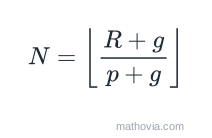
Fence Picket Spacing Calculator formula
The Fence Picket Spacing formula

The fence picket spacing formulas

is the run in inches, is the picket width, and is the target gap. pickets leave gaps, and the leftover run divides evenly among them.

Worked example

The calculator’s defaults are an 8-foot run, 5.5-inch pickets, a 0.5-inch target gap.

Convert the run: inches.

The 0.53-inch gap is a hair over the 0.5 requested — the correct outcome, since forcing exactly 0.5 would leave a visible sliver of extra space somewhere in the run.
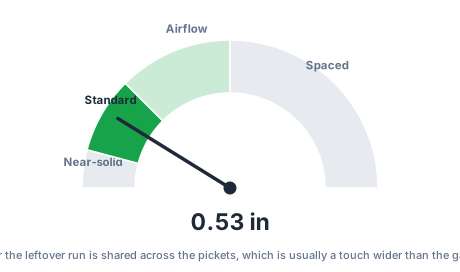
Fence Picket Spacing Calculator worked example diagram
A visual read of the worked example above — the same numbers the calculator returns for its default inputs.

What your results mean

With the defaults, an 8-foot section takes 16 pickets with 15 gaps of 0.53 inch each, on 6.03-inch centers. That gap is a hair wider than the 0.5 inch requested, which is the correct outcome: forcing exactly 0.5 inch would leave a half-inch sliver of extra space somewhere, and the eye catches that instantly. The spacing style label tells you where you have landed, from near-solid privacy under a quarter inch to open ranch-style spacing above 1.5 inches.

Practical tips

Cut a scrap spacer to the actual gap value rather than trusting a nail or a tape mark on every board. If the calculated gap drifts far from your target, change the picket count by one and rerun it: dropping a picket widens the gaps, adding one tightens them. Also check the result against your local code, since pool and child-safety enclosures often cap the gap at a fixed maximum regardless of how good it looks.

When to rip a picket instead

Sometimes no whole-picket count gives a gap you like. In that case, keep the gap you want and rip the two end pickets to equal narrower widths. Symmetric end boards read as intentional; a single odd gap does not.

Pickets for a whole fence

Run the calculator once per section, then multiply. A fence of six identical 8-foot sections needs pickets. Add 5–10% for split or warped boards, so order about 102. If one section is shorter, say next to a gate, run that one separately rather than averaging.

Marking the layout instead of using spacers

For long runs, marking on-centre positions avoids small spacer errors building up. With the default 6.03-inch on-centre spacing, mark the post rail at 0, 6.03, 12.06, 18.09 inches and so on, and line up the same edge of each picket with each mark. Check the last mark lands where the final picket should end before you fix anything.

Common mistakes

  • Measuring centre to centre between posts. The run is the clear space the pickets fill, from post face to post face, or the rail length if the pickets overlap the posts.
  • Using the nominal width. A 1×6 picket is about 5.5 inches wide. Measure a few, since widths vary between batches.
  • Ignoring shrinkage. Wet pressure-treated pickets shrink as they dry, so a tight gap opens up. Fit them a little tighter than the final gap you want.
  • Forgetting the bottom gap. Keep pickets about 2 inches above the ground so they don’t wick up moisture and rot.
About the formula: The picket count is the whole number of picket-plus-gap units that fit in the run, allowing one fewer gap than pickets. The leftover space is then divided across those gaps, so the real gap is usually slightly wider than the one you asked for.

Frequently Asked Questions

How many pickets do I need for an 8-foot fence section?+

With 5½-inch pickets and a ½-inch target gap: floor((96 + 0.5) ÷ 6) = 16 pickets, leaving 15 gaps of about 0.53 inch each.

Why is the actual gap wider than the gap I entered?+

Your target gap only estimates the picket count. Once that's rounded down to whole pickets, the leftover run is split evenly across the gaps, which nudges each one slightly wider.

What gap should I use for a privacy fence?+

Butt them tight or leave 1/8 to 1/4 inch. Wet pressure-treated pickets shrink as they dry, so boards installed touching often open to a 1/8–1/4 inch gap on their own within a few months.

Do I run this once for the whole fence?+

No — run it per section, measuring between the inside faces of each post pair. Post spacing varies across a yard, and averaging it leaves one visibly wrong gap somewhere.

What is on-center spacing and when do I use it?+

Picket width plus the gap — the distance from the left edge of one picket to the left edge of the next. Mark on-center distances along the rail if you'd rather use a tape than carry a spacer block down the fence.

How do I keep gaps even when the section length is awkward?+

Either accept the calculated gap (usually close to your target), or hold your exact gap and rip the two end pickets to matching narrower widths. Symmetric end boards look deliberate; one odd gap does not.

Related calculators