
Percentages are fractions with a denominator of 100 — 3/4 and 75% describe the exact same portion, just written two different ways. This chart lists the fraction-to-percent conversions that come up most often, so you don’t have to divide by hand every time.
Halves, quarters, and eighths
| Fraction | Percent |
|---|---|
| 1/2 | 50% |
| 1/4 | 25% |
| 3/4 | 75% |
| 1/8 | 12.5% |
| 3/8 | 37.5% |
| 5/8 | 62.5% |
| 7/8 | 87.5% |
Thirds and sixths
| Fraction | Percent |
|---|---|
| 1/3 | 33.33% |
| 2/3 | 66.67% |
| 1/6 | 16.67% |
| 5/6 | 83.33% |
Thirds and sixths never divide evenly into 100, so their percent equivalents repeat forever (33.333…%). The values above are rounded to two decimal places, which is precise enough for nearly every practical use.
Fifths and tenths
| Fraction | Percent |
|---|---|
| 1/5 | 20% |
| 2/5 | 40% |
| 3/5 | 60% |
| 4/5 | 80% |
| 1/10 | 10% |
| 3/10 | 30% |
| 7/10 | 70% |
| 9/10 | 90% |
Fifths and tenths always convert to clean, terminating percentages, since 5 and 10 both divide evenly into 100.
How the conversion works
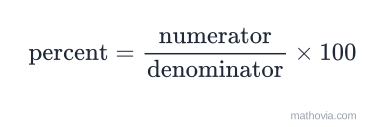
Every fraction converts to a percent the same way: divide the numerator by the denominator, then multiply by 100.
3/8 → 3 ÷ 8 = 0.375 → 0.375 × 100 = 37.5%
For a fraction that isn’t on this chart, or to double-check any of the values above, use the fraction to percent calculator — it also accepts mixed numbers and shows the decimal step in between.
Converting a percent back to a fraction
Going the other direction: write the percent over 100, then reduce. 40% becomes 40/100, which simplifies to 2/5. For a percent with a decimal, clear it first — 12.5% is 12.5/100, or 125/1000, which reduces to 1/8. A repeating percent like 33.33% is really 1/3 rounded; recognizing the common values above lets you snap it back to the exact fraction instead of carrying the rounding error forward.
Where this comes up
Grades, discounts, tips, interest rates, and survey results are usually reported as percentages even when the underlying number started as a fraction — “3 out of 4 questions right” is naturally 3/4, reported as 75%. Recognizing the common equivalents above by sight saves a division step in everyday situations like splitting a bill or reading a sale sign. For the reverse direction in detail, see the decimal to fraction calculator after dividing the percent by 100, and the decimal equivalents chart for the decimal values behind each fraction.