
Drywall mud — joint compound — is easy to under-buy, because every coat adds material and a real project loses a chunk to the bucket, the sanding block, and the corners. This calculator estimates the total gallons and how many buckets to buy, so you’re not stopping a finish coat to make a hardware-store run.
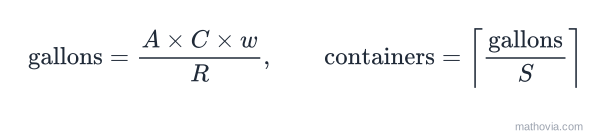
The drywall mud formula
Worked example
The calculator’s defaults are 1,000 sq ft, 2 coats, 10% waste, 100 sq ft per gallon, in 5-gallon buckets.
Four buckets would give only 20 gallons — two short.
Buckets by project size (2 coats, 10% waste, 100 sq ft/gal, 5-gal buckets)
| Drywall area | Gallons | 5-gal buckets |
|---|---|---|
| 300 sq ft (small room) | 6.6 | 2 |
| 800 sq ft (bedroom, walls + ceiling) | 17.6 | 4 |
| 1,000 sq ft | 22.0 | 5 |
| 2,000 sq ft (whole floor) | 44.0 | 9 |
How to Calculate Drywall Mud (step by step)
Step One: Account for waste
Start by increasing the drywall surface area by the selected waste factor. This creates a more realistic working area than the raw measurement alone.
Area including waste = drywall area × waste factor
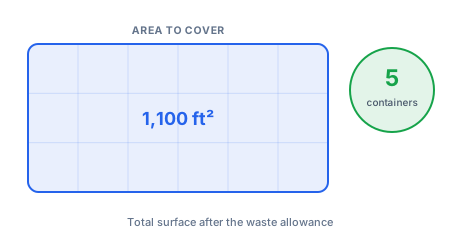
Area including waste = 1,000 × 1.10 = 1,100 sqft
Step Two: Calculate the total application area
Multiply the adjusted area by the number of coats. Each coat requires its own coverage, even when the second coat is thinner.
Total application area = area including waste × number of coats
Total application area = 1,100 × 2 = 2,200 sqft
Step Three: Calculate gallons of drywall mud
Divide the total application area by the product’s coverage per gallon. The default coverage is 100 square feet per gallon.
Drywall mud needed = total application area ÷ coverage per gallon
Drywall mud needed = 2,200 ÷ 100 = 22 gallons
Step Four: Calculate containers
Divide the total gallons by the selected container size and round up to the next whole container. With 5-gallon containers, 22 gallons requires five containers.
Containers needed = drywall mud needed ÷ container size
Containers needed = 22 ÷ 5 = 4.4
Rounded up = 5 containers
What your results mean
Area including waste is the adjusted surface area used in the estimate. It is not extra drywall; it is a planning allowance for material loss and application variability.
Drywall mud needed is the estimated volume of joint compound for all coats. The result depends heavily on the coverage rate, so use the manufacturer’s published coverage when available.
Containers needed is always rounded up. Buying four 5-gallon containers would provide only 20 gallons, leaving you 2 gallons short of the 22-gallon estimate.
Tips for a better estimate
Measure walls and ceilings separately, then add their areas before entering the total. Increase the waste allowance for heavily textured surfaces, extensive repairs, high ceilings, or first-time finishing work. Also remember that premixed compound and setting-type compound can have different coverage rates and working characteristics.