
How much concrete do you actually need?
Concrete is sold by volume, but most DIYers think in bags — which is where mistakes happen. A small footing might only need a handful of 60 lb bags, while a full driveway slab needs volume calculated first, then converted into a bag count (or, past a certain size, ready-mix delivered by the truckload instead).
Volume first, bags second
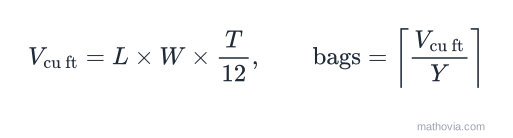
The calculator above works in two steps: it finds the cubic footage of your pour (length × width × thickness), then divides that by your bag’s yield to get a bag count. This order matters — if you only think in bags from the start, it’s easy to misjudge a slab that’s thicker or larger than it looks.
The concrete bags formula
Worked example
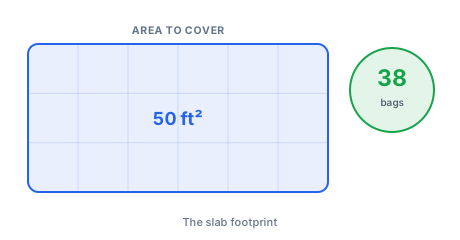
The calculator’s defaults are a 10 ft × 5 ft slab, 4 inches thick, using 60-lb bags.
In cubic yards:
Bag count by slab size (4 inches thick, 60-lb bags)
| Slab | Volume | 60-lb bags | 80-lb bags |
|---|---|---|---|
| 3 × 3 ft | 3.0 cu ft | 7 | 5 |
| 4 × 8 ft | 10.7 cu ft | 24 | 18 |
| 10 × 5 ft | 16.7 cu ft | 38 | 28 |
| 10 × 10 ft | 33.3 cu ft | 75 | 56 |
| 12 × 20 ft | 80.0 cu ft | 178 | 134 |
The 10 × 10 ft row is already 75 bags — the point where mixing by hand stops making sense and ready-mix delivery takes over.
When to switch to ready-mix
Once you’re past roughly 1 cubic yard (about 45 sixty-pound bags), ready-mix delivery usually becomes cheaper and far less labor-intensive than mixing bags by hand. Use this calculator to find your volume first, then decide which route makes sense for your project size.
A note on curing
Bag count gets you the pour started, but strength depends on proper curing — keeping the slab moist for the first several days, especially in hot or windy weather. A fast cure in harsh conditions is a common cause of surface cracking.
Allow for waste
Uneven ground, spillage and a slightly thick pour all eat concrete. Most guides add about 10% before buying. For the default slab:
Three extra bags cost far less than a second trip to the store halfway through a pour.
Thickness matters more than it looks
Going from 4 inches to 6 inches thick adds 50% more concrete. The same 10 × 5 ft slab at 6 inches is 25 cubic feet, which is 56 sixty-pound bags instead of 38. Driveways and slabs that carry vehicles are often poured thicker than patios, so check the thickness before you count bags.
Post holes and footings
For a round hole, use the volume of a cylinder:
That’s about 2.7 eighty-pound bags, so plan on 3 per hole. The post itself takes up a little room, but rounding up covers waste.
Common mistakes
- Entering thickness in feet. The formula divides inches by 12. Typing 0.33 for a 4-inch slab gives a pour 12 times too small.
- Using the wrong bag yield. The yield is 0.30, 0.45 or 0.60 cu ft for 40-, 60- and 80-lb bags. Working out the count with the 80-lb yield and then buying 60-lb bags leaves you about a quarter short.
- Skipping the waste allowance. Running short mid-pour leaves a cold joint, a weak seam where fresh concrete meets concrete that has started to set.
- Pouring on a soft or uneven base. Low spots swallow extra concrete and can crack the slab later.