
Block walls are one of the few estimating jobs where the arithmetic comes out exact, because concrete masonry units are sized so that everything lands on whole feet. A course is eight inches, a block is sixteen long, and an eight-foot wall is twelve courses with nothing cut. That tidiness is deliberate, and once you know where it comes from the count almost falls out on its own.
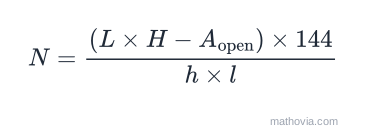
The block count formula
For standard block the whole thing collapses to one number:
So net wall area × 1.125 is the count for standard CMU, and that is the version worth memorising.
Why the nominal size is not the real size
A block sold as 8 × 8 × 16 actually measures 7 5/8 inches on every dimension. The missing 3/8 of an inch is the mortar joint. Add the joint and each block occupies exactly 8 by 16 inches of wall:
This is why block courses stack to whole feet, why a door rough opening is designed in 8-inch increments, and why the count works on nominal dimensions rather than the ones your tape measures. Use the actual 7 5/8 figure in the formula and you will over-order by about 10 percent.
Worked example
A garden wall 20 feet long and 8 feet high, in standard 8 × 16 block, with no openings.
Step 1 — net wall area.
Step 2 — blocks per square foot for this face size.
Step 3 — multiply.
Step 4 — check it against the course layout.
Two independent routes to the same number is a good sign. Add 5 percent for breakage and you would order 189 blocks, and at roughly 30 blocks to a 70-pound bag that wall takes 6 bags of mortar.
Blocks per square foot by face size
| Block face | Face area | Blocks per sq ft |
|---|---|---|
| 8 in × 16 in (standard) | 128 sq in | 1.125 |
| 6 in × 16 in | 96 sq in | 1.5 |
| 4 in × 16 in (cap / soap) | 64 sq in | 2.25 |
| 8 in × 8 in (half block) | 64 sq in | 2.25 |
Notice that block thickness — 4, 6, 8, 10 or 12 inches — does not appear anywhere. A 6-inch-thick block and a 12-inch-thick block with the same 8 × 16 face cover identical wall area, so the count is the same. Thickness changes the price, the weight and the structural capacity, not how many you need.
Common wall sizes
| Wall | Net area | Standard blocks |
|---|---|---|
| 10 ft × 4 ft | 40 sq ft | 45 |
| 20 ft × 4 ft | 80 sq ft | 90 |
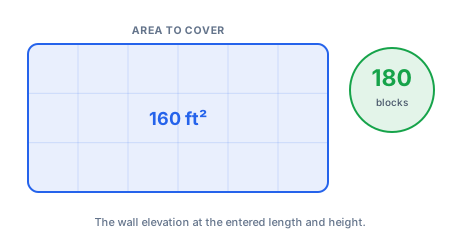
| 20 ft × 8 ft | 160 sq ft | 180 |
| 30 ft × 8 ft | 240 sq ft | 270 |
| 40 ft × 8 ft | 320 sq ft | 360 |
| 50 ft × 10 ft | 500 sq ft | 563 |
Mortar, and what else the count does not cover
Mortar. Around one 70-pound bag of pre-blended mortar mix per 25 to 30 standard blocks, which is roughly three bags per hundred. If you are mixing from scratch rather than buying pre-blended, a common type S recipe is one part masonry cement to about three parts sand by volume.
Corners. Every corner needs corner blocks with one finished end, and it interrupts the running bond. Count corners separately and add a couple of blocks per corner per few courses.
Lintels. Any opening wider than about 3 feet needs a lintel or bond beam block over it, plus rebar and grout. Those are a separate order.
Rebar and grout. Reinforced walls have vertical bar in grouted cells at intervals set by code and by wall height. The rebar spacing calculator handles the bar layout, and the grout volume comes from the number of filled cells — roughly 0.19 cubic feet per standard block cell.
The footing. A block wall sits on a poured footing, typically twice the wall thickness wide and at least 8 inches deep, below the frost line. That is its own concrete order — the concrete bags calculator or a ready-mix delivery, depending on size.
Common mistakes
- Using the actual 7 5/8 in dimensions. The count works on nominal 8 and 16. The joint makes up the difference.
- Letting block thickness change the count. It does not. Only the face dimensions matter.
- Subtracting every small opening. Below about 10 sq ft the cut blocks and jamb pieces eat the saving. Leave them in.
- Forgetting the waste allowance. Five percent, minimum. Blocks chip in transit and corners break under a saw.
- Ordering mortar by block count alone. Rough-textured or split-face block takes noticeably more mortar than smooth CMU.
- Ignoring the top course. A wall that finishes with cap block needs a different face size for that course — 4 × 16 caps take 2.25 per square foot, not 1.125.
For the footing pour under the wall, the concrete bags calculator converts dimensions into bags, and the concrete PSI calculator covers what strength mix the footing and any grouted cells should be.