
Asphalt is quoted by the ton, laid by the inch and measured by the foot, so ordering it means running a small chain of conversions before you can pick up the phone. Get the thickness wrong by half an inch on a driveway and you are a ton out, which is real money and — worse — a load that cannot be sent back once it has left the plant hot.
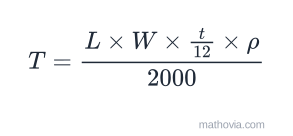
The asphalt tonnage formula
The three moving parts are worth separating, because each one trips people up differently:
| Term | What it is | Usual value |
|---|---|---|
| thickness converted from inches to feet | 3 in → 0.25 ft | |
| unit weight of the compacted mix | 145 lb/cu ft | |
| 2000 | pounds in a US short ton | fixed |
Worked example
A residential driveway, 50 ft long and 12 ft wide, finished at 3 inches of standard hot mix.
Step 1 — convert the thickness to feet.
Step 2 — get the compacted volume in cubic feet.
Step 3 — multiply by density for the weight in pounds.
Step 4 — divide by 2,000 for tons.
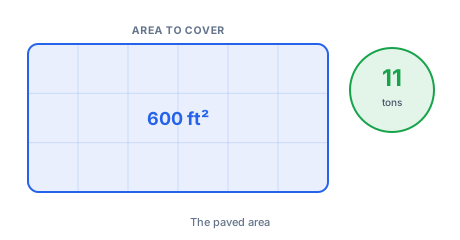
At $120 a ton that is $1,305 in material. Add the usual 5 to 10 percent for screed loss and edge feathering and you would order 11.5 tons.
The same job in cubic yards is
Coverage per ton
One ton of 145 lb/cu ft hot mix is
| Compacted thickness | One ton covers |
|---|---|
| 1 in | 165 sq ft |
| 1.5 in | 110 sq ft |
| 2 in | 83 sq ft |
| 2.5 in | 66 sq ft |
| 3 in | 55 sq ft |
| 4 in | 41 sq ft |
| 6 in | 28 sq ft |
The quick field rule is 165 divided by the thickness in inches. It is close enough for a phone call and only drifts if you are running an unusual mix density.
How thick should it be?
| Application | Compacted asphalt | Aggregate base under it |
|---|---|---|
| Residential driveway | 2–3 in | 4–8 in |
| Heavy residential (RV, boat) | 3 in | 8 in |
| Commercial parking, cars only | 3 in | 6–8 in |
| Commercial with truck traffic | 4 in, two lifts | 8–12 in |
| Local road | 4–6 in, two lifts | 12 in |
The base matters more than most people expect. Asphalt is a flexible pavement — it spreads load rather than bridging it the way a concrete slab does, so it is only ever as good as what is underneath. Paving three inches over a soft or poorly compacted subgrade buys you a driveway that cracks in its second winter. If the base is questionable, the money is better spent there than on an extra inch of surface. The gravel calculator handles the base tonnage.
Compacted versus loose thickness
This is the single most common error on a first driveway, and it goes in the expensive direction.
Hot mix arrives loose and is compacted by the roller to roughly 75 to 80 percent of its laid depth. So a finished 3-inch surface is screeded at close to 3.75 inches:
Enter the compacted thickness in this calculator, not the loose one. The density figure of 145 lb/cu ft already describes the material after rolling. If you enter the loose depth as well, you double-count the compaction and over-order by about a quarter.
Mix types and why the density differs
| Mix | Density (lb/cu ft) | Where it is used |
|---|---|---|
| Surface course (HMA) | 145 | the visible top layer |
| Dense-graded binder | 148 | the structural lift under the surface |
| Recycled asphalt (RAP) | 140 | driveways, base repair, budget work |
| Open-graded / porous | 130 | drainage-critical lots, some roads |
| Cold mix patch | 135 | pothole repair, winter work |
Open-graded mixes weigh less because the voids are deliberate — water is meant to pass through. That means a porous lot of the same size and thickness needs roughly 10 percent less tonnage than a dense-graded one, which is easy to miss when you reuse a number from a previous job.
What the tonnage does not include
Base and sub-base. Priced and ordered separately, usually by the ton as well.
Tack coat. The bituminous bond between lifts or against an existing surface. Sold by the gallon, roughly 0.05 to 0.10 gal per square yard.
Compaction and labour. Typically the larger half of an installed quote. Material at $120 a ton on a 600 sq ft driveway is around $1,300; the installed price for that job is usually $2,500 to $4,000.
Edge and transition material. Feathering into a garage apron or a street tie-in eats mix that the rectangle calculation does not see. It is part of why the 5 to 10 percent margin exists.
Common mistakes
- Entering the loose depth. Use the compacted thickness. The density already accounts for rolling.
- Dividing thickness by 3 instead of 12. Inches to feet is 12. It is the same slip that turns square feet into nonsense.
- Reusing 145 lb/cu ft for a porous mix. Open-graded runs near 130, and the 10 percent gap shows up on a big lot.
- Forgetting the base. Asphalt over an uncompacted subgrade fails early regardless of how thick the surface is.
- Ordering the exact figure. Add 5 to 10 percent. Leftover hot mix cannot be stored, but running short mid-pave leaves a cold joint across the drive.
- Confusing short tons with metric tonnes. This calculator uses US short tons of 2,000 lb. A metric tonne is 2,205 lb, about 10 percent more.
Once the surface tonnage is settled, the cubic yard calculator converts the same volume for suppliers who quote by yard, and the square footage calculator handles the area if the drive is anything other than a plain rectangle.