
Bulk material is ordered by the cubic yard and measured with a tape in feet and inches, and that mismatch is where most over- and under-ordering comes from. Concrete, topsoil, mulch, gravel, sand and fill are all sold this way. The conversion is a single division, but the number you divide by surprises people the first time.
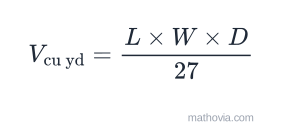
The cubic yard formula
A 4-inch slab is
Where the 27 comes from
A yard is three feet, and volume is three dimensions, so every side triples:
This is the same trap as square feet, one dimension worse. Dividing cubic feet by 3 converts nothing — it just produces a smaller wrong number. The factor is 27, and it is worth committing to memory because it comes up on every bulk delivery you will ever order.
For reference, one cubic yard is also 0.7646 cubic metres, 202 US gallons, and roughly the volume of a chest freezer.
Worked example
Take a patio slab 10 ft long, 10 ft wide, poured 4 inches thick.
Step 1 — convert the depth to feet.
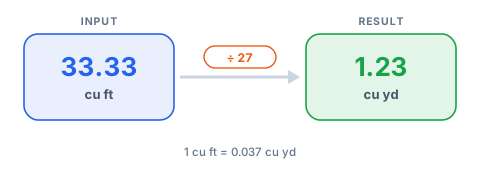
Step 2 — multiply the three dimensions for cubic feet.
Step 3 — divide by 27.
Step 4 — round up to what the supplier will actually sell.
At $165 a yard that pour costs $247.50 in material. The quarter-yard of headroom is not waste — it is the margin that covers a subgrade that dipped half an inch in the middle, which every subgrade does.
Coverage: one cubic yard at different depths
A cubic yard is 27 cubic feet, so the area it covers depends entirely on how thick you spread it. Divide 324 by the thickness in inches to get the coverage in square feet:
| Thickness | One cubic yard covers |
|---|---|
| 1 in | 324 sq ft |
| 2 in | 162 sq ft |
| 3 in | 108 sq ft |
| 4 in | 81 sq ft |
| 5 in | 65 sq ft |
| 6 in | 54 sq ft |
| 8 in | 40.5 sq ft |
| 12 in | 27 sq ft |
The 324 is just
Cubic feet to cubic yards conversion table
| Cubic feet | Cubic yards |
|---|---|
| 27 | 1 |
| 54 | 2 |
| 81 | 3 |
| 100 | 3.70 |
| 135 | 5 |
| 200 | 7.41 |
| 270 | 10 |
| 500 | 18.52 |
Going the other way, multiply cubic yards by 27. In metric, one cubic yard is 0.7646 cubic metres and one cubic metre is 1.308 cubic yards.
Typical depths worth knowing
| Job | Usual depth |
|---|---|
| Concrete patio or walkway | 4 in |
| Concrete driveway (cars) | 4 in |
| Concrete driveway (trucks, RV) | 5–6 in |
| Gravel driveway base | 4–6 in |
| Mulch on beds | 2–3 in |
| Topsoil for new lawn | 4–6 in |
| Sand under pavers | 1 in |
Depth drives cost far harder than area does, because it multiplies straight through. Going from 4 inches to 6 on a 400 sq ft driveway adds half again to the concrete bill — that is a real decision, not a detail.
How much to order
Suppliers sell in whole and half yards, and most add a short-load fee below three or four yards. Two habits are worth having.
Round up, always. The calculator does this for you at the half yard. A pour that comes up short cannot be rescued by a second truck an hour later — the joint between the two batches will show, and it will be a weak line for the life of the slab.
Add waste on top of the rounding. Five to ten percent for concrete, because forms bow and subgrade dips. Ten to fifteen for soil and mulch, which both settle noticeably in the first month. If you are ordering 6 yards of topsoil for a lawn, order 7.
For a small job it can still be cheaper to mix bags yourself than to pay a short-load fee. The concrete bags calculator works out the bag count, and the crossover is usually somewhere around half a cubic yard.
Common mistakes
- Dividing cubic feet by 3. The factor is 27. Three is the length conversion, not the volume one.
- Leaving depth in inches. Multiplying 10 × 10 × 4 gives 400, a number in no unit at all. Convert to feet first.
- Measuring depth as the finished height. For a slab it is the pour thickness, not the height from the ground to the top of the form.
- Ordering the exact calculated figure. Nobody delivers 1.235 yards, and nobody wants to be short.
- Forgetting the thickened edge. Many slabs are 4 inches in the field and 8 to 12 at the perimeter. That edge is extra volume — measure it as its own strip and add it.
- Ignoring compaction on soil. Loose topsoil settles by roughly 10 to 20 percent once watered in. The hole you are filling needs more than its own measured volume.
Once you have the yardage, the gravel calculator converts it to tons if your supplier prices by weight, and the square footage calculator handles the area step if the shape is anything other than a rectangle.