
Understanding the Watts to Btu/h Conversion
When working with heating systems, air conditioning units, or any equipment that bridges electrical and thermal power ratings, you’ll frequently encounter both watts and Btu per hour. Watts are the universal SI unit of power, measuring the rate at which energy is transferred. Btu per hour, on the other hand, remains the dominant unit for expressing thermal output in the United States, particularly in HVAC specifications and building energy codes.
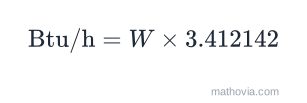
The core relationship between these units comes from the definition of the British Thermal Unit itself: one BTU is the energy required to raise the temperature of one pound of water by one degree Fahrenheit. When expressed as a rate over time, the conversion to the metric watt yields the factor 3.412142. Forgetting this constant or confusing it with the inverse (0.293071 W per Btu/h) is the most common mistake people make when sizing equipment or comparing product datasheets across unit systems.
This converter eliminates that guesswork. Enter any wattage value and get an accurate Btu/h equivalent, useful for matching electric heater output to furnace ratings, interpreting appliance labels, or verifying HVAC load calculations.
The watts to Btu/h formula
The factor is the reciprocal of the 0.293071 W per Btu/h relationship: one BTU is about 1,055.06 joules, so
Worked example
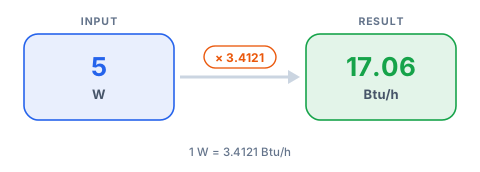
The calculator’s default is 5 W.
A practical case: a 1,500 W electric space heater.
which is why a 1,500 W plug-in heater is often marketed as “5,000 BTU.”
What Is a Watt?
A watt (W) is the SI derived unit of power, defined as one joule of energy transferred per second. In electrical terms, one watt equals the power dissipated when a current of one ampere flows through a potential difference of one volt. The unit is named after Scottish inventor James Watt and serves as the foundation for measuring power consumption and output across electrical, mechanical, and thermal systems worldwide.
Using Watt’s Law, power is:
with
What Is a Btu per Hour?
A Btu per hour (Btu/h) is a unit of power in the US customary system representing one British Thermal Unit of energy expended over one hour. Since one BTU is defined as the heat needed to raise one pound of water by 1 °F, the Btu/h effectively measures thermal delivery rate. You’ll see this unit on furnace nameplates, air conditioner capacity stickers, and building heat-loss calculations throughout North America.
The abbreviation Btu/h uses a solidus (/) to indicate “per unit time,” following the same notational convention as other rate-based units like miles per hour (mi/h).
Quick Reference Table
| Watts | Btu/h |
|---|---|
| 1 W | 3.4121 Btu/h |
| 5 W | 17.0607 Btu/h |
| 10 W | 34.1214 Btu/h |
| 50 W | 170.607 Btu/h |
| 100 W | 341.214 Btu/h |
| 500 W | 1,706.07 Btu/h |
| 1,000 W | 3,412.14 Btu/h |
| 1,500 W | 5,118.21 Btu/h |
| 2,000 W | 6,824.28 Btu/h |
| 5,000 W | 17,060.71 Btu/h |
Heat from electronics
Almost all the electricity a computer or server uses ends up as heat in the room. A PC drawing 400 W adds about:
A small server room with 3 kW of equipment adds about 10,236 Btu/h, close to a 1-ton (12,000 Btu/h) air conditioner’s capacity before counting people, lights or sunlight.
Common mistakes
- Mixing Btu with Btu/h. Btu is an amount of energy; Btu/h is a rate. A heater rating is in Btu/h.
- Using an air conditioner’s electrical draw as its cooling output. A unit drawing 1,000 W can move around 10,000–12,000 Btu/h of heat. Use the rated cooling capacity, not the watts it consumes.
- Rounding to 3.4 for big loads. Over 100 kW, that’s off by about 1,200 Btu/h.