
Grout is easy to under-buy, because the amount doesn’t scale with floor area alone. Small tiles have far more joint length per square foot than large ones; wider and deeper joints hold more; and every job loses some to mixing and spillage. This calculator combines all of that into a volume estimate you can take to the grout aisle.
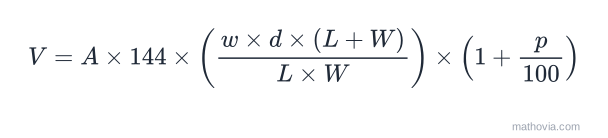
The grout volume formula
Worked example
The calculator’s defaults are 100 sq ft of 12 × 12 inch tile, 1/8-inch (0.125) joints, 3/8-inch (0.375) deep, 10% waste.
Joint fraction:
Volume:
That’s
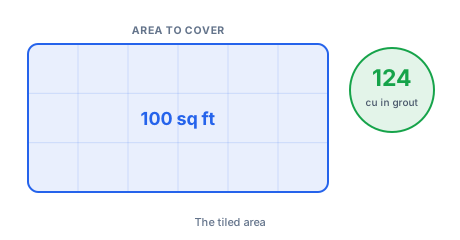
How tile size drives grout use
Same 100 sq ft, 1/8-inch joints 3/8-inch deep, 10% waste:
| Tile size | Grout volume |
|---|---|
| 2 × 2 in (mosaic) | ~742 cu in |
| 4 × 4 in | ~371 cu in |
| 6 × 6 in | ~247 cu in |
| 12 × 12 in | ~124 cu in |
| 24 × 24 in | ~62 cu in |
A mosaic sheet uses roughly six times the grout of large-format tile over the same floor.
How to Calculate Tile Grout (step by step)
Step One: Convert the tiled area to square inches
The calculator uses inches for tile and joint dimensions, so convert the coverage area from square feet to square inches.
Tiled area = 100 × 144 = 14,400 sq in
Step Two: Calculate the grout joint volume for one tile pattern
For a repeating tile pattern, estimate the joint length around one tile, then multiply it by the joint width and depth.
Joint length = 2 × (tile length + tile width)
Effective shared joint length per tile = 12 + 12 = 24 in

Joint volume ratio = (0.125 × 0.375 × 24) ÷ (12 × 12)
Joint volume ratio = 0.0078125
Step Three: Calculate the base grout volume
Multiply the converted area by the joint volume ratio.
Base grout volume = 14,400 × 0.0078125 = 112.50 cu in
Step Four: Add the waste allowance
The default waste allowance is 10%, so multiply the base volume by 1.10.
Grout needed = 112.50 × (1 + 10 ÷ 100)
Grout needed = 112.50 × 1.10 = 123.75 cu in
Step Five: Convert the result to cubic feet
There are 1,728 cubic inches in one cubic foot.
Grout needed = 123.75 ÷ 1,728 = 0.072 cu ft
What your results mean
The primary result is the estimated grout volume in cubic inches. The cubic-foot result gives the same estimate in a larger unit that can be easier to compare with product packaging or bulk material measurements.
This is a volume estimate, not a bag count. Grout products differ in powder density, mixing ratios, and coverage efficiency, so use the product label to convert the calculated volume into the number of bags or containers to purchase. Buying slightly more than the exact estimate is usually safer than running short during installation.
For irregular tiles, wide joints, highly textured tile faces, or uneven substrates, increase the waste allowance. A careful installation with consistent joint depth will generally use less grout than a rough or irregular surface.