
Kick a ball, throw a stone, fire a water rocket: once it leaves your hand, only gravity steers it. That makes projectile motion one of the few physics problems you can solve exactly with a handful of equations. This calculator does all of them at once, giving range, maximum height, time of flight, the velocity components and the speed at impact, and draws the path to scale so you can see the shape of the answer.
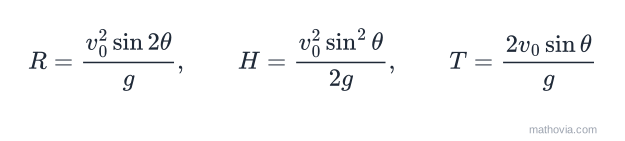
The projectile motion equations
Those three shortcuts only hold when the projectile lands at the height it was launched from. The general method, which the calculator uses for any launch height, splits the motion into two independent parts:
- Horizontal: constant speed, because nothing pushes sideways once it’s airborne.
- Vertical: constant downward acceleration g.
The vertical equation is a quadratic in t, which is why the path is a parabola. Solving it for y = 0 gives the time of flight. That’s the same algebra as the quadratic applications lesson, just with gravity supplying the numbers.
How to calculate projectile motion (step by step)
The calculator opens on a ball launched at 20 m/s, 30° above the horizontal, from ground level, with g = 9.81 m/s².
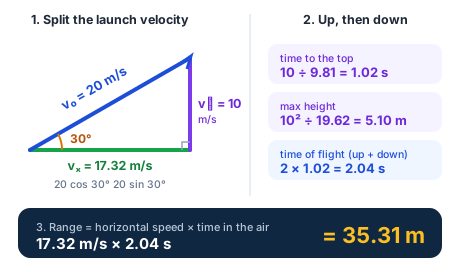
Step One: Split the launch velocity into components
The launch speed is the hypotenuse of a right triangle, so cosine gives the horizontal part and sine gives the vertical part. The right triangle calculator shows the same split with sides and angles.
vx = v₀ cos θ = 20 × cos 30° = 17.32 m/s
vy = v₀ sin θ = 20 × sin 30° = 10 m/s
Step Two: Find the time to the top
At the highest point, the vertical velocity is zero. Gravity removes 9.81 m/s of it every second.
t_top = vy ÷ g = 10 ÷ 9.81 = 1.019 s
Step Three: Find the maximum height
H = h₀ + vy² ÷ 2g = 0 + 100 ÷ 19.62 = 5.097 m
Step Four: Find the time of flight
From ground level the trip down mirrors the trip up, so the total is twice the time to the top. From a height, use T = (vy + √(vy² + 2gh₀)) ÷ g instead.
T = 2 × 1.019 = 2.039 s
Step Five: Find the range
Horizontal speed never changes, so distance is just speed × time.
R = vx × T = 17.32 × 2.039 = 35.31 m
On level ground the ball lands at the same speed it was launched (20 m/s), angled 30° below the horizontal. It’s the launch mirrored.
Launch angle and range
Keep the speed at 20 m/s and change only the angle, and you can see why 45° is famous:
| Angle | Range | Max height | Time in the air |
|---|---|---|---|
| 15° | 20.39 m | 1.37 m | 1.06 s |
| 30° | 35.31 m | 5.10 m | 2.04 s |
| 45° | 40.77 m | 10.19 m | 2.88 s |
| 60° | 35.31 m | 15.29 m | 3.53 s |
| 75° | 20.39 m | 19.02 m | 3.94 s |
The range peaks at 45° and is symmetric around it: 30° and 60° land in exactly the same spot, as do 15° and 75°. The steeper partner just takes a higher, slower route. When the calculator’s launch height is 0 and your angle isn’t 45°, the graph shows the 45° path as a dashed line for comparison.
Launching from a height
Throwing off a cliff, a balcony or the top of a ramp changes things, because the projectile has extra distance to fall. A ball thrown horizontally at 15 m/s from a 10 m cliff:
vy = 0, so the fall time depends only on the height:
t = √(2h ÷ g) = √(20 ÷ 9.81) = 1.428 s
range = 15 × 1.428 = 21.42 m
impact speed = 20.52 m/s, at 43.0° below horizontal
A dropped ball and a ball thrown sideways from the same height hit the ground at the same moment. It surprises almost everyone the first time, and it follows directly from the horizontal and vertical motions being independent. Launching from a height also pulls the best angle below 45°, which is why shot-putters release the shot at around 37° to 40°.
Throwing on the Moon and Mars
Gravity is the only force in these equations, so lower gravity means longer flights. The same 20 m/s throw at 30° goes:
Earth (9.81 m/s²):  35.3 m range, 5.1 m high, 2.04 s
Moon  (1.62 m/s²):  213.8 m range, 30.9 m high, 12.35 s
Range and height scale with 1/g, so the Moon’s gravity, about a sixth of Earth’s, gives about six times the distance. The gravity buttons in the calculator switch between Earth, the Moon, Mars and Jupiter, or you can type any value.
Working backwards: what speed do you need?
Sometimes the distance is fixed and the launch speed is the unknown. Rearranging the level-ground range formula gives the speed needed to land at a given spot:
v₀ = √(R × g ÷ sin 2θ)

to reach 50 m at 45°:   v₀ = √(50 × 9.81 ÷ 1)        = 22.15 m/s
to reach 30 m at 30°:   v₀ = √(30 × 9.81 ÷ sin 60°)  = 18.43 m/s
Try those speeds in the calculator to confirm the range comes out at 50 m and 30 m. The 45° throw needs the least speed for its distance, which is the flip side of 45° giving the longest range for a given speed.
What the calculator leaves out
These are the ideal equations, with no air resistance, no spin and a flat, non-rotating Earth. For a dense, slow object such as a shot put or a stone, they’re close. For a fast, light one such as a badminton shuttle, a baseball off the bat or a golf ball with backspin, drag and lift change the path a lot, and the real range can be half of what the formulas say.
Common mistakes
- Calculator in radian mode. sin 30 in radians is −0.988, not 0.5. Make sure angles are in degrees.
- Using the level-ground range formula from a height. R = v₀² sin 2θ / g assumes the landing point is level with the launch point.
- Mixing speed and velocity components. Time and height come from vy only, and range from vx only. Never put the full launch speed into the vertical equation.
- Giving g the wrong sign. If up is positive, the acceleration is −g. Mixing conventions within one problem is the classic source of negative times.
- Forgetting the launch height. A ball released 2 m above the ground travels noticeably farther than the h₀ = 0 answer.