Mathovia

Electrical / Power & Wattage

Kilowatt-Hours (kWh) to Amp-Hours (Ah) Conversion Calculator

Convert battery or electrical energy from kilowatt-hours to amp-hours by entering the energy capacity and system voltage.

Amp-Hours
100.00 Ah
Watt-Hours
1,200.0 Wh
000.541.67183.331.51252166.67kWhAh1.2 kWh100 Ah
1 kWh = 83.33333 Ah
Written by
MPhil in Mathematics, Founder of Mathovia
Published

Mathematics verification: Mathematical formulas, calculations, worked examples and solutions are reviewed for accuracy before publication. How we check our work

Kilowatt-Hours (kWh) to Amp-Hours (Ah) Conversion Calculator formula
The Kilowatt-Hours (kWh) to Amp-Hours (Ah) Conversion formula

Why you need the voltage

A kilowatt-hour is an amount of energy. An amp-hour is an amount of charge. They are not the same kind of quantity, and there is no fixed conversion between them — it depends entirely on the voltage the charge sits at. A 1.2 kWh battery is 100 Ah at 12 V, 50 Ah at 24 V, or 25 Ah at 48 V. Feed the calculator the energy and the system voltage and it returns the charge.

This comes up when a battery or storage system is specified in kWh — as home batteries and EV packs usually are — but you need amp-hours to size a charge controller, set a battery monitor, or pick cable.

The kWh to amp-hours formula

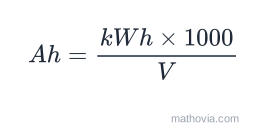
Multiply kilowatt-hours by 1,000 to get watt-hours, then divide by the nominal system voltage. The calculator also shows the intermediate watt-hour figure.

Worked example

The calculator’s defaults are 1.2 kWh at 12 V.

Watt-hours:

Amp-hours:

So 1.2 kWh at 12 V is 100 Ah of nominal capacity.
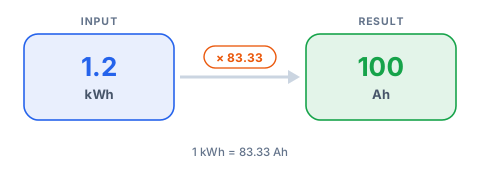
Kilowatt-Hours (kWh) to Amp-Hours (Ah) Conversion Calculator worked example diagram
A visual read of the worked example above — the same numbers the calculator returns for its default inputs.

kWh to amp-hours at common voltages

Energy12 V24 V48 V
1.2 kWh100 Ah50 Ah25 Ah
2.4 kWh200 Ah100 Ah50 Ah
5 kWh417 Ah208 Ah104 Ah
10 kWh833 Ah417 Ah208 Ah

The amp-hour figures at 12 V get large fast. A 10 kWh bank at 12 V is 833 Ah — a lot of parallel cells and very heavy interconnects. The same 10 kWh at 48 V is 208 Ah, which is why nearly every home-scale battery system runs at 48 V or higher.

Nominal versus usable

The result is nameplate capacity. Usable amp-hours are fewer:

At 80% depth of discharge and 90% system efficiency, the 100 Ah example gives Ah you can actually count on.

Common mistakes

  • Using the charging voltage instead of nominal, which understates the amp-hours.
  • Sizing a 12 V bank for a large kWh target and ending up with impractical cable and cell counts.
  • Treating nominal Ah as usable Ah.

For the reverse, use the amp-hours to kWh calculator. For runtime under a load, see the battery runtime calculator.

Frequently Asked Questions

How do I convert kilowatt-hours to amp-hours?+

Multiply kWh by 1,000 to get watt-hours, then divide by the system voltage: Ah = (kWh × 1,000) ÷ V.

How many amp-hours is 1.2 kWh at 12 volts?+

100 Ah, since 1.2 × 1,000 ÷ 12 = 100. At 24 V the same 1.2 kWh is only 50 Ah, and at 48 V it's 25 Ah.

How big a 12V battery bank do I need for 5 kWh of storage?+

5 kWh ÷ 12 V ≈ 417 Ah nominal. After a depth-of-discharge limit and losses you'd size larger — roughly 500 Ah of lithium or 800+ Ah of lead-acid to reliably use 5 kWh.

Does this give usable capacity?+

No, it gives nominal amp-hours. Multiply by the usable fraction (about 0.8 lead-acid, 0.9+ lithium) and system efficiency for a practical figure.

Why does higher voltage mean fewer amp-hours for the same kWh?+

Energy is charge times voltage. Hold the energy fixed and raise the voltage, and the charge — the amp-hours — has to fall in proportion. That's the main argument for 48 V battery banks: less current, thinner cable, smaller losses.

Which voltage should I enter?+

The nominal system voltage — 12, 24, or 48 V — not the charging voltage. Ratings are defined against nominal.

Related calculators