The widget above reads the current Gregorian year straight from your device’s local date. That sounds like the least interesting question a calendar can answer — the year only changes once every 365 days, after all — but the number sitting there carries more arithmetic than it lets on. Whether it’s a leap year is a modular-arithmetic question. Writing it in Roman numerals is a place-value exercise. And it is only one of the years currently in use: the same afternoon has a different year number in Jerusalem, Mecca, Bangkok and Beijing. Below is how each of those is worked out.
Is this year a leap year?
The rule is three tests, applied in order. A year is a leap year when it divides evenly by 4, unless it also divides evenly by 100, unless it further divides evenly by 400. In remainder notation:
Try it on 2026. Dividing by 4 gives 506 remainder 2, so the first test already fails and 2026 is a 365-day year. The next February 29 lands in 2028. The century exception is the part people forget: 2000 divided by 400 exactly, so it was a leap year, while 1900 wasn’t and 2100 won’t be.
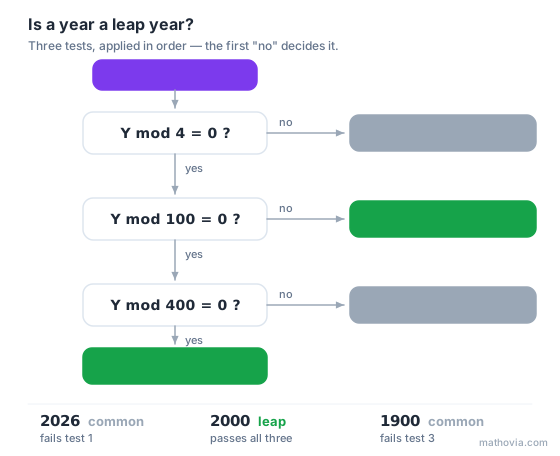
That awkward third rule exists because the Earth doesn’t cooperate. A tropical year is about 365.2422 days, not 365.25, so the plain every-fourth-year rule the Julian calendar used overshoots by roughly 11 minutes a year. Skipping three leap days every four centuries pulls the average down to 365.2425 — close enough that the calendar drifts by only about a day every three thousand years.
The current year in Roman numerals
Convert each place value on its own, then write the parts left to right. For 2026:
| Place | Value | Numeral |
|---|---|---|
| Thousands | 2000 | MM |
| Hundreds | 0 | — |
| Tens | 20 | XX |
| Ones | 6 | VI |
| Whole year | 2026 | MMXXVI |
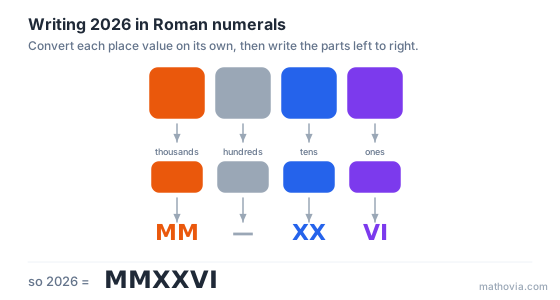
So 2026 is MMXXVI. The only place the subtractive trick appears in nearby years is the tens and ones — 2029 ends in IX, not VIIII. Years in this century stay short because M is worth a full thousand; 1888 was the longest year ever written, at MDCCCLXXXVIII, thirteen characters.
How far through the year are you?
Two numbers answer this, and both come out of a single day count. If
On the 246th day of a 365-day year, that’s
The same year on other calendars
The Gregorian year is the international civil standard, not the only count in use. Several calendars are a fixed offset away, which makes them a one-step conversion:
| Calendar | Year during 2026 | Conversion from the Gregorian year |
|---|---|---|
| Gregorian | 2026 | — |
| Julian | 2026, but dated 13 days earlier | subtract 13 days from the date |
| Thai Buddhist | 2569 | add 543 |
| Holocene | 12026 | add 10,000 |
| Byzantine (Anno Mundi) | 7534, then 7535 from 1 September | add 5,508, or 5,509 after 1 September |
| Hebrew | 5786, then 5787 from 11 September 2026 | add 3,760, or 3,761 after Rosh Hashanah |
| Islamic (Hijri) | 1447, then 1448 from 16 June 2026 | no fixed offset |
| Chinese zodiac | Fire Horse, from 17 February 2026 |
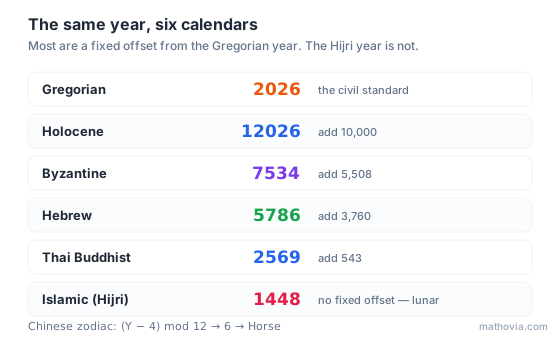
The Islamic calendar is the one that refuses to line up. It is purely lunar, so its year runs about 354 days — roughly 11 days shorter than the Gregorian year — and the offset between the two shrinks by that much annually. Over about 33 Gregorian years the Hijri count gains a full year, which is why Ramadan migrates through the seasons rather than sitting in one.
The Chinese zodiac animal is easier arithmetic than it looks. Take
Why the numbering starts where it does
The count traces to Dionysius Exiguus, a monk who in the 520s proposed numbering years from what he calculated as the birth of Christ. His system spread slowly and his arithmetic was probably off by a few years, but the epoch stuck. AD and BC are the traditional labels; CE and BCE are the same numbers with religiously neutral names, and are now standard in academic writing.
There is no year 0 — the sequence runs 1 BC straight into AD 1. That single missing year is the reason the 21st century officially runs from 2001 to 2100 rather than 2000 to 2099, and why the “which year does the century start?” argument comes back every hundred years. Decade names dodge the whole problem by just following the tens digit: the 2020s are 2020 through 2029, and nobody disputes it.
How computers count the year
Most systems don’t store a year at all. They store one integer: the number of seconds elapsed since midnight UTC on 1 January 1970, the Unix epoch. Every date you see is that number converted on the fly.
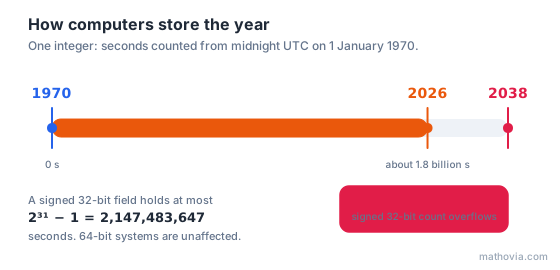
The catch is the size of the box it goes in. A signed 32-bit integer maxes out at 2,147,483,647, and that many seconds after 1970 lands on 19 January 2038. One second later the count overflows into negative numbers and reads back as 1901. That’s the Year 2038 problem, and it’s the same class of bug as Y2K — a field too small for the number it has to hold. Modern 64-bit systems push the limit roughly 292 billion years out, so it’s now mostly a concern for old embedded hardware.
Things people get wrong about the year
- Assuming every fourth year is a leap year. 1900 and 2100 are the counterexamples.
- Treating 2000 as the start of the 21st century. By the strict count it was the last year of the 20th.
- Expecting the year to be the same worldwide. For a few hours each New Year it isn’t.
- Adding a fixed number to get the Islamic year. There isn’t one — the lunar year drifts.
- Reading a Julian date as a Gregorian one. Between 1900 and 2100 they sit 13 days apart.
Related time tools
For the full date and the month, see today’s date and what month is it. To place yourself inside the year, use what day of the year it is, days left in the year, or what week of the year it is. To see the whole thing laid out as a grid, open the 2026 calendar or look ahead to 2027.