“Today” feels like it ought to be a single global fact, but a calendar date is a local property, not a universal one — it depends on where you are, not only on what moment it is. The widget above settles that by reading your own device’s clock and time zone. The rest of this page is the arithmetic underneath: how a date is put together, how to write it so nobody misreads it, how to find its position in the year, and how to work out the weekday in your head.
The parts of a date
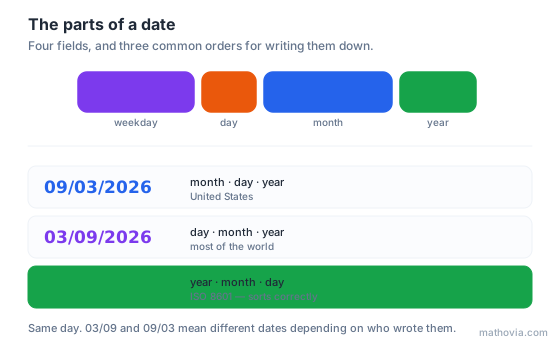
A full date carries four fields, and only three of them are independent. The day, month and year pin down the date; the weekday is derived from those three, which is why you can calculate it rather than look it up.
Writing the date so nobody misreads it
This is the one part of the topic that causes real damage. 03/09/2026 means 3 September to most of the world and 9 March in the United States, and nothing in the string itself tells you which. Any day-of-month below 13 is ambiguous, which is most of the month.
Two fixes work. Spell the month out — 3 September 2026 — or use ISO 8601: 2026-09-03. The ISO form has a property the others lack: because the most significant field comes first and every field is zero-padded to a fixed width, sorting the text alphabetically also sorts it chronologically. That is why it turns up in filenames, logs and database columns, and it’s worth defaulting to whenever a date has to be read by a machine as well as a person.
Where today sits in the year
Two numbers place a date inside its year, and both come from a running total of month lengths. The day of the year is the days in all previous months plus the day of the month:
where
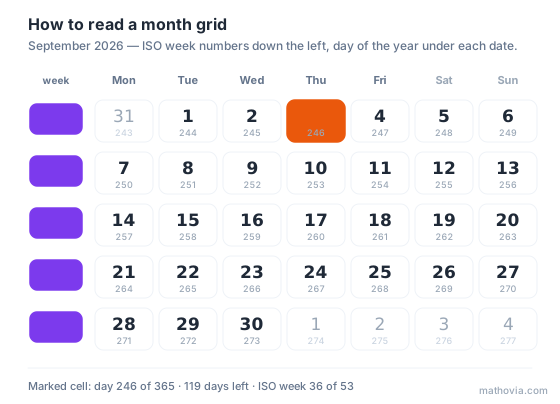
Our day of the year tool does this live, and days left in the year handles the subtraction.
How week numbers work
ISO 8601 also standardises weeks, and the rule is less obvious than it looks. Weeks start on Monday, and week 1 is the week containing the year’s first Thursday — equivalently, the week holding 4 January. A consequence people find surprising is that the first days of January often belong to the last week of the previous year, and the last days of December sometimes belong to week 1 of the next.
Most years hold 52 weeks. A year gets a 53rd when it starts on a Thursday, or on a Wednesday in a leap year. 2026 begins on a Thursday, so it runs 53 weeks — see what week of the year it is for the live number.
Work out the weekday in your head
Because the weekday is derived, you can compute it. The doomsday rule is the quickest hand method: every year has one weekday — its doomsday — shared by 4/4, 6/6, 8/8, 10/10, 12/12, and 9/5. Anchor to that weekday and count.
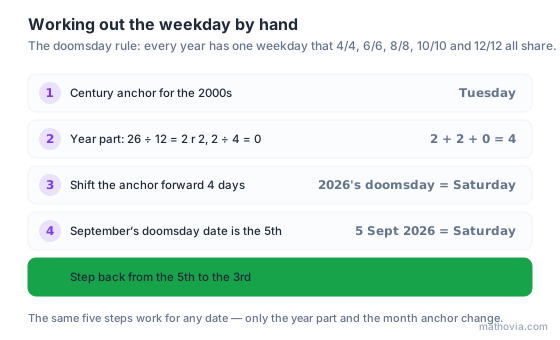
The century anchor for the 2000s is Tuesday. For the year part, divide the two-digit year by 12, then divide the remainder by 4, and add all three pieces: for 26 that’s
Why two people can disagree about today
A date is meaningless without a time zone attached. Each zone crosses into the next date at its own local midnight, so at any given instant two calendar dates are in use somewhere on Earth. The effect is at its most extreme either side of the international date line.
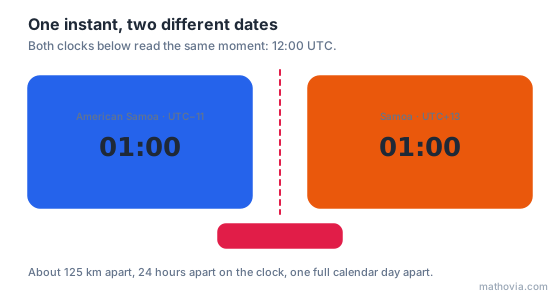
Apia sits at UTC+13 and Pago Pago at UTC−11 — 24 hours apart on paper. At 12:00 UTC both read one in the morning, but one is on Friday and the other still on Thursday. The same thing happens between any two zones in milder form: Tokyo can be well into a new date while Los Angeles has hours of the old one left.
Computers dodge all of this by not storing a date at all. They store a single count of seconds from a fixed epoch and convert on demand — covered in more detail on what year is it.
The full 2026 calendar
Here is the whole year in one view, with weeks starting on Monday. 2026 is a common year: 365 days, beginning on a Thursday and ending on one, which is what gives it 53 ISO weeks rather than the usual 52.
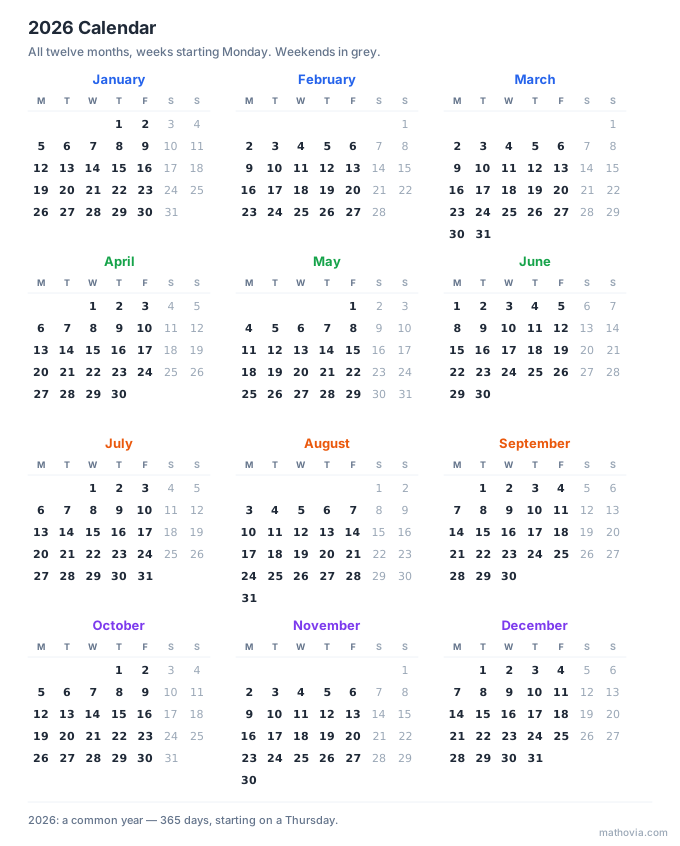
A few dates worth having: 1 January falls on a Thursday, 25 December on a Friday, and February has 28 days because 2026 fails the divisible-by-4 test. For an interactive month-by-month version, open the 2026 calendar — or look ahead to the 2027 calendar, which starts on a Friday.
Common mix-ups
- Reading 03/09 without knowing who wrote it. Ambiguous for 12 of every 31 days.
- Assuming week 1 is the week of 1 January. It’s the week of the first Thursday.
- Expecting every year to have 52 weeks. Some have 53.
- Treating UTC as “the” date. UTC fixes the instant, not the calendar day you’re on.
- Trusting a device with the wrong time zone. The date here is only as right as your system settings.
Calendars and related tools
To see whole months laid out, open the 2026 calendar or the 2027 calendar. For the fields on their own, see what month is it and what year is it. For position within the year, use what day of the year, what week of the year, or days left in the year.