
Why this conversion is a common trap
Phone, laptop, tablet, drone, and power-bank batteries are almost always advertised in milliamp-hours. That number looks like a capacity you can compare across products, but it isn’t — mAh measures charge, and charge only becomes energy once you multiply by voltage. A “20,000 mAh” power bank and a “20,000 mAh” laptop battery store wildly different amounts of energy because they run at different voltages. Converting Wh to mAh (or back) is how you check what a replacement cell, a spec-sheet figure, or a marketing number really means.
The watt-hours to milliamp-hours formula
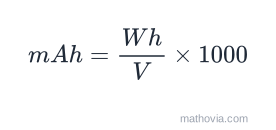
Divide the energy by the nominal cell voltage to get amp-hours, then multiply by 1,000 for milliamp-hours. For a single lithium-ion cell,
Worked example
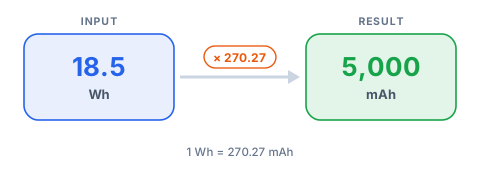
The calculator’s defaults are 18.5 Wh at 3.7 V.
Amp-hours first:
Then milliamp-hours:
So an 18.5 Wh cell at 3.7 V is a 5,000 mAh cell. If that same 18.5 Wh were packaged as an 11.1 V 3S pack, it would be only about 1,667 mAh — same energy, less than a third of the mAh number.
The voltage makes or breaks the number
| Energy | at 3.7 V | at 7.4 V | at 11.1 V |
|---|---|---|---|
| 10 Wh | 2,703 mAh | 1,351 mAh | 901 mAh |
| 18.5 Wh | 5,000 mAh | 2,500 mAh | 1,667 mAh |
| 50 Wh | 13,514 mAh | 6,757 mAh | 4,505 mAh |
| 100 Wh | 27,027 mAh | 13,514 mAh | 9,009 mAh |
This is why a 100 Wh airline limit doesn’t map to a single mAh figure. At the 3.7 V cell level it’s about 27,000 mAh; at 11.1 V it’s about 9,000 mAh.
What the result assumes
The conversion uses nominal voltage, an average across the discharge curve. A full lithium cell reads about 4.2 V and a near-empty one about 3.0 V, so a fresh-off-the-charger reading would overstate the mAh. Real delivered capacity also drops a little with fast discharge, cold, and age.
Common mistakes
- Using 3.7 V for a multi-cell pack, which multiplies the mAh several times over.
- Comparing mAh across devices with different voltages — compare Wh instead.
- Using the peak charged voltage rather than nominal.
For the reverse, use the mAh to watt-hours calculator. For full-size batteries, see watt-hours to amp-hours.