
Making the mAh number mean something
A milliamp-hour rating on a phone or power bank tells you about charge, not energy. On its own it can’t be compared across devices that run at different voltages. Watt-hours can — it’s charge times voltage, the actual amount of stored energy. Converting mAh to Wh is what lets you compare a power bank to a laptop battery, check a pack against the 100 Wh airline carry-on limit, or work out how many phone charges a bank really holds.
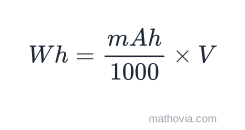
The milliamp-hours to watt-hours formula
Scale the milliamp-hours down to amp-hours, then multiply by the nominal voltage. For a single lithium-ion cell that voltage is about 3.7 V; for a multi-cell pack, use the pack’s rating (7.4 V for 2S, 11.1 V for 3S).
Worked example
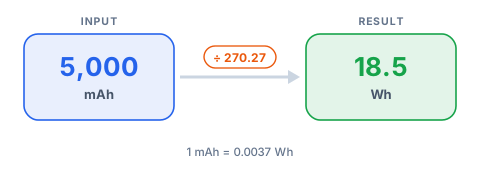
The calculator’s defaults are 5,000 mAh at 3.7 V.
Amp-hours first:
Then watt-hours:
So a 5,000 mAh cell at 3.7 V holds 18.5 Wh.
What “20,000 mAh” really buys you
A 20,000 mAh power bank at 3.7 V is
mAh to Wh at common voltages
| mAh | 3.7 V | 7.4 V | 11.1 V |
|---|---|---|---|
| 2,000 | 7.4 Wh | 14.8 Wh | 22.2 Wh |
| 5,000 | 18.5 Wh | 37.0 Wh | 55.5 Wh |
| 10,000 | 37.0 Wh | 74.0 Wh | 111 Wh |
| 26,800 | 99.2 Wh | 198 Wh | 297 Wh |
The 26,800 mAh row at 3.7 V lands at 99.2 Wh — just under the 100 Wh airline threshold, which is exactly why that odd-looking capacity is so common on travel power banks.
What the result assumes
Nominal voltage is an average across the discharge; a full cell reads about 4.2 V, a flat one about 3.0 V. Delivered energy also drops slightly with fast discharge, cold, and age. The figure is the nameplate rating.
Common mistakes
- Using 3.7 V for a multi-cell pack, which undercounts the energy.
- Ignoring conversion losses when estimating device charges from a power bank.
- Comparing mAh across voltages instead of converting to Wh.
For the reverse, use the watt-hours to mAh calculator. For full-size batteries, see amp-hours to watt-hours.