
From apparent power to real power
Apparent power in kVA is what an AC source has to supply — voltage times current, reactive part included. Real power in watts is the portion that actually does something: heat, light, motion. The bridge between them is the power factor, the fraction of the apparent power that turns into work.
This version of the conversion lands the answer in watts rather than kilowatts, which is the friendlier unit when you’re looking at a single appliance, a piece of AV gear, or a UPS load rather than a whole panel. The math is identical to the kVA-to-kW conversion; only the scale of the output changes.
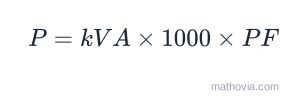
The kVA to watts formula
Worked example
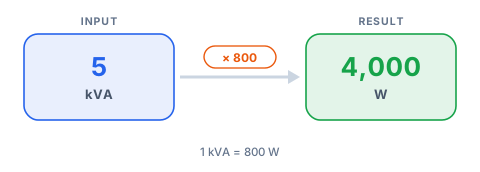
The calculator’s defaults are 5 kVA at a power factor of 0.8.
Convert to volt-amps:
Apply the power factor:
So the load draws 5,000 VA from the supply but consumes 4,000 W. The 1,000 VA gap is reactive power the wiring carries and the meter ignores.
kVA to watts by power factor
| kVA | PF 1.0 | PF 0.95 | PF 0.8 | PF 0.65 |
|---|---|---|---|---|
| 0.5 | 500 W | 475 W | 400 W | 325 W |
| 1 | 1,000 W | 950 W | 800 W | 650 W |
| 3 | 3,000 W | 2,850 W | 2,400 W | 1,950 W |
| 5 | 5,000 W | 4,750 W | 4,000 W | 3,250 W |
Modern IT equipment with power-factor-corrected supplies sits near the 0.95–1.0 columns. A rack of older gear, or a load with motors, drifts toward 0.8 or below.
When to trust this, and when not to
The result is only as good as the power factor you feed it. For a resistive load — a heater, a filament lamp — use 1.0 and the watts equal the VA. For anything with a switch-mode supply or a motor, the power factor varies with how heavily the device is loaded, so a single assumed value is an estimate. If the appliance prints a wattage on its label, that measured figure beats any calculation.
Common mistakes
- Leaving power factor at 0.8 for a resistive load. That undercounts the watts by 20%.
- Reading the VA rating of a UPS as its watt rating. They’re different limits; check both.
- Forgetting the ×1,000. kVA to watts needs it; kVA to kW does not.
For the kilowatt version, use the kVA to kW calculator. For the reverse direction, see watts to kVA.