
Why convert volts to watts
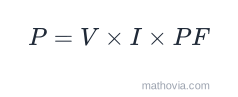
Voltage on its own tells you almost nothing about power. A 120 V outlet feeds a phone charger drawing a couple of watts and a hair dryer drawing eighteen hundred, and the voltage is identical in both cases. What separates them is current. Multiply the two together and you get power — with one adjustment for alternating-current motor and electronic loads, called the power factor.
This calculation comes up whenever you have a voltage and a current reading and need the wattage behind them: checking that a nameplate’s stated volts and amps actually match its rated watts, sizing a generator around the real load on a circuit, estimating running cost from a clamp-meter reading, or confirming a solar or battery system can carry what you want to plug into it.
The volts to watts formula
For a single-phase AC circuit:
For a three-phase circuit, using line-to-line voltage:
The power factor is the part people skip and then wonder why their numbers don’t match. It represents the fraction of the volt-amps flowing in the circuit that actually turns into work. A resistive load — heat, incandescent light — has a power factor of 1. A motor or a cheap switch-mode supply pulls extra current that flows in and out of a magnetic field without doing anything, so its power factor drops to somewhere between 0.6 and 0.9.
Worked example
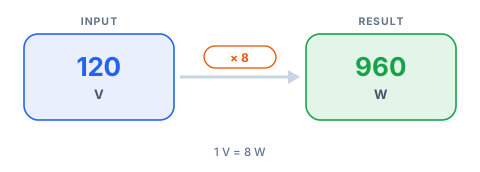
The calculator’s defaults describe a single-phase circuit at 120 V carrying 10 A with a power factor of 0.8.
Multiply voltage by current to get the apparent power:
Then scale by the power factor to get real power:
So the load consumes 960 watts. The remaining 240 VA is reactive power — it loads the wiring and the breaker but never registers on the utility meter and never heats or turns anything.
If that same load were resistive, the power factor would be 1 and the full 1,200 W would be real power. That gap between 960 W and 1,200 W for identical voltage and current is exactly why power factor belongs in the formula.
Three-phase worked example
A three-phase circuit at 208 V line-to-line, carrying 15 A per line, at a power factor of 0.85:
The √3 factor is there because the three line currents are 120° out of phase with one another, so the total power isn’t simply three times the single-line figure.
Volts and amps to watts, at a glance
Assuming a resistive load (power factor 1):
| Voltage | 1 A | 5 A | 10 A | 15 A | 20 A |
|---|---|---|---|---|---|
| 12 V | 12 W | 60 W | 120 W | 180 W | 240 W |
| 120 V | 120 W | 600 W | 1,200 W | 1,800 W | 2,400 W |
| 240 V | 240 W | 1,200 W | 2,400 W | 3,600 W | 4,800 W |
For a motor or electronic load, multiply the table value by the power factor. A 10 A motor on 240 V at a power factor of 0.85 delivers about 2,040 W, not 2,400 W.
What the result does and doesn’t tell you
The watts figure is the real power the load consumes at the instant you took the readings. It is not necessarily the load’s rated wattage — a motor started under load, a heater mid-cycle, or a dimmed lamp all draw less than their nameplate figure. It also isn’t the apparent power the wiring carries; that’s the volts-times-amps number before the power-factor scaling, and it’s the one that matters for conductor and breaker sizing.
Common mistakes
- Assuming power factor is 1 for everything. It inflates the wattage for any motor, transformer, or non-corrected electronic load.
- Using phase voltage instead of line-to-line voltage in the three-phase formula, or forgetting the √3 entirely.
- Reading current with a clamp meter and calling volts × amps “watts.” That’s VA. Real power is lower by the power factor.
- Mixing 120 V and 240 V. A 240 V appliance read as 120 V halves the wattage.
For the reverse calculation, use the watts to volts calculator. To find the current a known wattage draws, see watts to amps, and for resistance-based circuits, volts to amps applies Ohm’s law directly.