Mathovia

Electrical / Power & Wattage

Kilowatts (kW) to Volt-Amps (VA) Conversion Calculator

Calculate apparent power in VA from real power in kW.

Apparent Power
5,000.0 VA
001.251,5632.53,1253.754,68856,250kWVA4 kW5,000 VA
1 kW = 1,250 VA

Use the stated electrical relationship and enter values in the displayed units.

Source: Formula conventions follow standard electrical engineering relationships. Verify equipment ratings and local code requirements before installation.

Written by
MPhil in Mathematics, Founder of Mathovia
Published

Mathematics verification: Mathematical formulas, calculations, worked examples and solutions are reviewed for accuracy before publication. How we check our work

Kilowatts (kW) to Volt-Amps (VA) Conversion Calculator formula
The Kilowatts (kW) to Volt-Amps (VA) Conversion formula

Real power in, apparent power out

A load’s real power in kilowatts is the work it does. Its apparent power in volt-amps is what the source has to deliver, including the reactive current that flows without doing work. For any load that isn’t purely resistive, the second number is larger, and the ratio between them is the power factor.

This calculator gives the answer in VA rather than kVA, which is the right scale for the equipment that usually needs it: control transformers, low-voltage lighting transformers, small isolation transformers, and compact UPS units are all specified in volt-amps.

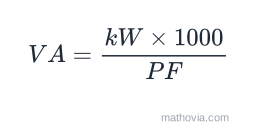
The kW to VA formula

is apparent power, is real power, and is the power factor from 0 to 1. The 1,000 converts kilowatts to watts; dividing by the power factor recovers the apparent power the source must supply.

Worked example

The calculator’s defaults are 4 kW at a power factor of 0.8.

Convert to watts:

Divide by the power factor:

The load consumes 4,000 W but the source has to provide 5,000 VA. The 1,000 VA difference is reactive — carried by the transformer and wiring, doing no work.
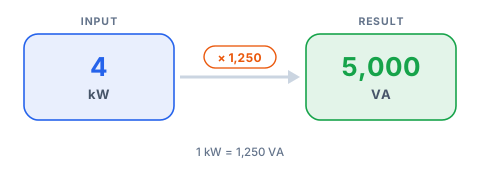
Kilowatts (kW) to Volt-Amps (VA) Conversion Calculator worked example diagram
A visual read of the worked example above — the same numbers the calculator returns for its default inputs.

kW to VA by power factor

Real powerPF 1.0PF 0.9PF 0.8PF 0.6
0.5 kW500 VA556 VA625 VA833 VA
1 kW1,000 VA1,111 VA1,250 VA1,667 VA
4 kW4,000 VA4,444 VA5,000 VA6,667 VA
10 kW10,000 VA11,111 VA12,500 VA16,667 VA

Sizing a control transformer

Control transformers have a second trap beyond power factor: inrush. When a contactor or solenoid coil first picks up, it pulls a large VA spike for a cycle or two — often three to eight times its sealed (holding) VA. That’s why control transformers carry both an inrush VA and a sealed VA rating. Size the transformer so its inrush capacity covers the simultaneous pick-up of every coil that can energize at once, and its continuous rating covers the steady sealed load — the figure this calculator produces is the steady one.

Common mistakes

  • Using power factor 0.8 for a resistive load. A heater is unity power factor; VA equals watts.
  • Ignoring coil inrush when the VA figure is for a control circuit.
  • Confusing VA with watts on a UPS spec. They are separate limits.

For the kilovolt-amp version, use the kW to kVA calculator. For the reverse, see VA to kW.

About the formula: Use the stated electrical relationship and enter values in the displayed units.

Frequently Asked Questions

How do I convert kW to VA?+

Multiply the kilowatts by 1,000 to get watts, then divide by the power factor. VA = (kW × 1000) ÷ PF. The result is apparent power, always equal to or larger than the real power.

What is 4 kW in VA?+

At a power factor of 0.8, that's (4 × 1000) ÷ 0.8 = 5,000 VA. At unity power factor it would be 4,000 VA. The lower the power factor, the more VA a source must provide for the same 4 kW.

Why convert to VA rather than kVA?+

For small equipment. Control transformers, low-voltage lighting transformers, and compact UPS units are specified in VA. Larger switchgear and generators use kVA to avoid trailing zeros. The two units differ only by a factor of 1,000.

Can I size a UPS or control transformer straight from this VA figure?+

Use it as the baseline, then add 20 to 25% for load growth and inrush. Also check the device's watt rating separately — a UPS has both a VA limit and a watt limit, and you can't exceed either.

Does a control transformer need extra VA for inrush?+

Yes. Contactor and solenoid coils pull a large inrush VA for the first cycle or two when they pick up — often several times their sealed (holding) VA. Control transformers are rated with both an inrush and a sealed VA figure for this reason.

Is VA the same as watts for a resistive load?+

Yes. At a power factor of 1 — heaters, incandescent lamps — VA and watts are numerically equal, so 4 kW is simply 4,000 VA.

Related calculators