
Mulch is bought by volume, but you experience it as a depth spread over an area — so the first job is turning bed dimensions and a target depth into cubic yards or a bag count. Order short and you leave bare patches that weeds find within weeks; order long and you’re stacking leftover bags in the garage until next spring.
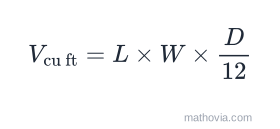
The mulch volume formula
Worked example
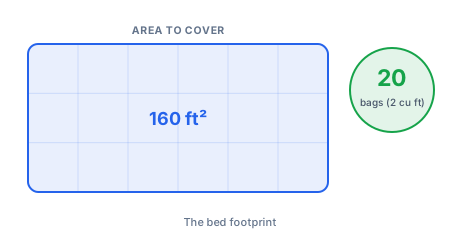
The calculator’s defaults are a 20 ft × 8 ft bed at 3 inches deep.
So the bed needs about 1.5 yards of bulk mulch, or 20 bags.
Coverage from one cubic yard
| Depth | Area one cubic yard covers |
|---|---|
| 1 inch | 324 sq ft |
| 2 inches | 162 sq ft |
| 3 inches | 108 sq ft |
| 4 inches | 81 sq ft |
At the recommended 2–3 inches, a yard of mulch dresses roughly a 10 × 12 to 10 × 16 foot bed.
Getting mulch depth right
Mulch does real work in a garden bed — it suppresses weeds, retains soil moisture, and moderates soil temperature — but only within a fairly narrow depth range. Too thin and weeds punch through within weeks; too thick and it can suffocate plant roots or hold excess moisture against stems.
Why 2-3 inches is the sweet spot
Below 2 inches, sunlight still reaches weed seeds near the surface. Above 3-4 inches, water has a harder time reaching the soil underneath, and mulch piled against trunks or stems can encourage rot. Most landscaping guidance converges on 2-3 inches for a reason — it’s the range that solves the weed/moisture problem without creating new ones.
Buying in bulk vs. bags
Bagged mulch is usually sold in 2 cubic foot bags. Once a project needs more than roughly 2-3 cubic yards (27-40+ bags), bulk delivery is almost always the better value — most landscaping suppliers deliver by the yard at a lower effective cost than the equivalent bags.
Refreshing existing beds
If a bed already has mulch from a previous season, you often don’t need a full new layer — measure the existing depth first and only add enough to bring it back to 2-3 inches total, rather than starting the calculation from zero.
Common mistakes
- Measuring depth in inches but forgetting to divide by 12. The formula needs depth in feet; 3 inches is 0.25 ft, not 3.
- Ordering to the exact figure. Add 5–10% for settling, uneven ground, and spreading loss.
- Piling mulch against trunks (“mulch volcanoes”), which traps moisture against bark and invites rot and pests.
- Confusing bag sizes. Bark mulch is usually 2 cu ft per bag; some rubber and stone mulches are 0.8 or 1 cu ft, so the bag count changes.
For other bulk landscape materials, the gravel calculator works the same way in tons, and the concrete bags calculator covers volume-to-bag conversions for slabs and footings.