
Paint is bought by the gallon but applied by the square foot, over as many coats as it takes to look right. This calculator turns an area, a coat count, and a coverage rate into a gallon figure — rounded up, because a mid-wall paint run leaves a lap mark that shows for the life of the finish.
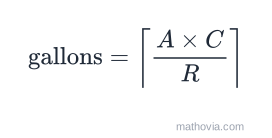
The paint coverage formula
Worked example
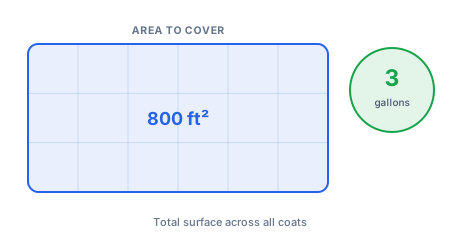
The calculator’s defaults are 400 sq ft, 2 coats, and 350 sq ft per gallon.
So the job needs 3 gallons. Two gallons would cover 700 sq ft — a hundred short of the second coat.
Paint needed by room size (2 coats, 350 sq ft/gal)
| Room | Wall area (approx.) | Gallons |
|---|---|---|
| Bathroom (5 × 8 ft) | ~210 sq ft | 2 |
| Bedroom (12 × 12 ft) | ~380 sq ft | 3 |
| Living room (16 × 20 ft) | ~560 sq ft | 4 |
| Whole small apartment | ~1,400 sq ft | 8 |
Wall area is the room perimeter times ceiling height, minus openings.
Why paint cans are optimistic
Every can lists a coverage rate, but that number assumes ideal conditions — a smooth, previously painted wall in good shape. Real walls rarely match, which is why the gallon estimate is a range more than a single number.
What changes your real coverage
- Unprimed drywall or new plaster soaks up significantly more paint than a previously painted wall — expect 20-30% lower coverage on the first coat.
- Textured surfaces (orange peel, knockdown, brick) increase surface area beyond what the flat square footage suggests.
- Dark-to-light color changes often need an extra coat regardless of what the can promises.
Two coats is the default for a reason
Most professional painters apply two coats even when a product claims “one-coat coverage,” simply because lighting and viewing angle reveal thin spots that looked fine while wet. Budgeting for two coats from the start avoids a frustrating mid-project paint run.
A simple way to avoid running short
Buy your calculated amount, but ask if your paint store will accept an unopened return — that way you can round up without worrying about waste if you overestimate.
Common mistakes
- Using the whole room area instead of just the walls (or forgetting the ceiling if you’re painting it).
- Ignoring the surface. Bare drywall and rough stucco drink paint; adjust the coverage rate down.
- Counting one coat when the colour change needs two or three — going light over dark almost always does.
- Forgetting primer as its own separate calculation.
For other coverage-based material estimates, see the drywall mud calculator, which works the same way with a waste allowance built in.
Measuring a room’s wall area
Multiply the perimeter by the ceiling height, then subtract doors and windows. For a 12 × 14 ft room with 8-foot ceilings, one door (3 × 7 ft) and two windows (3 × 5 ft each):
At two coats and 350 square feet per gallon, that’s
Primer is its own calculation
Primer often covers less than paint, around 200–300 square feet per gallon on new drywall. For the 365 square feet above, one coat at 300 square feet per gallon is
Trim and doors
Trim is painted with a brush and uses little paint by area. A quart of trim paint usually covers the doors, frames and skirting of one or two average rooms. Measure only if you’re painting many doors: each side of a standard door is about 20 square feet.