Mathovia

Electrical / Power & Wattage

Kilowatts (kW) to Amps Conversion Calculator

Calculate current from real power and circuit conditions.

Current
12.50 A
001.256.512.513.023.7519.53526.04kWA2.4 kW12.5 A
1 kW = 5.20833 A

Use the stated electrical relationship and enter values in the displayed units.

Source: Formula conventions follow standard electrical engineering relationships. Verify equipment ratings and local code requirements before installation.

Written by
MPhil in Mathematics, Founder of Mathovia
Published

Mathematics verification: Mathematical formulas, calculations, worked examples and solutions are reviewed for accuracy before publication. How we check our work

Kilowatts (kW) to Amps Conversion Calculator formula
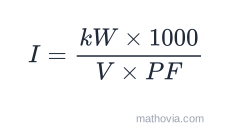
The Kilowatts (kW) to Amps Conversion formula

Why convert kW to amps

Machinery, heaters, HVAC compressors, and EV chargers list their draw in kilowatts. The circuit that feeds them is defined by amps — the breaker rating, the wire gauge, the disconnect size. This conversion is the step between a nameplate and a panel schedule: it tells you the current a kW-rated load will pull so you can check it against an existing circuit or design a new one.

Three things shape the answer. Voltage sets the baseline — the same kW at 240 V draws half the current it would at 120 V. The system type matters — a three-phase feed spreads the load across three conductors, cutting the per-line current by about 42%. And for motors and electronic loads, the power factor pushes the current up, because some of it is reactive and does no work.

The kW to amps formula

Single-phase:

Three-phase, line-to-line voltage:

is current in amps, is real power, is voltage, and is the power factor. For a resistive load, set .

Worked example

The calculator’s defaults are 2.4 kW on a single-phase 240 V circuit at a power factor of 0.8.

Convert to watts:

Divide by voltage and power factor:

The load draws 12.5 A. If it were a resistive 2.4 kW heater instead — power factor 1 — the same circuit would carry only 10 A. The 2.5 A difference is the reactive current that a power factor of 0.8 implies.
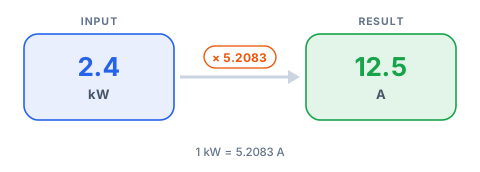
Kilowatts (kW) to Amps Conversion Calculator worked example diagram
A visual read of the worked example above — the same numbers the calculator returns for its default inputs.

kW to amps reference (single-phase, PF 1)

Power120 V240 V
1 kW8.3 A4.2 A
2 kW16.7 A8.3 A
3 kW25 A12.5 A
5 kW41.7 A20.8 A
7.5 kW62.5 A31.3 A
10 kW83.3 A41.7 A

For a motor load, divide each figure by the power factor. For three-phase, divide by 1.732 as well.

From running current to circuit size

The current here is the steady operating draw. The breaker and conductor go above it:

  • Continuous loads (on 3+ hours) are sized to 125% of the current, so a 12.5 A continuous load wants a circuit rated at least 15.6 A — a 20 A breaker in practice.
  • Motor inrush briefly reaches several times the running current; the breaker must ride through it without tripping.
  • Derating for high ambient temperature or bundled conductors can force the wire up a gauge.

Common mistakes

  • Wrong system type. Selecting single-phase for a three-phase load overstates the current by ~73%.
  • Power factor 0.8 for a resistive heater. Use 1.0, or the current reads 25% high.
  • Sizing the breaker to the raw current instead of applying the 125% continuous margin.

For the reverse, use the amps to kilowatts calculator. To convert to apparent power for generator sizing, see kW to kVA.

About the formula: Use the stated electrical relationship and enter values in the displayed units.

Frequently Asked Questions

How many amps is 2.4 kW at 240 volts?+

For a resistive load at a power factor of 1, 2,400 ÷ 240 = 10 A. At the calculator's default 0.8 power factor it's 2,400 ÷ (240 × 0.8) = 12.5 A. Motor loads need the higher figure; a heater or water heater draws the lower one.

How does this kW to amps conversion work?+

Real power is voltage times current times power factor, and times √3 for three-phase. Rearranged for current, you divide the power in watts by voltage, by the phase factor, and by the power factor.

How much does single-phase versus three-phase change the answer?+

A lot — about 42%. Three-phase puts a √3 (1.732) in the denominator, so the same kW load draws that much less current per line on three-phase than on single-phase. Choosing the wrong system type is the most common way to get a badly wrong number here.

Can I pick a wire size or breaker from this current?+

Not on its own. Wire and breaker sizing follows the ampacity tables, temperature and conduit-fill derating, and a 125% margin for continuous loads. This is the raw running current before any of that.

Why does a lower power factor mean more amps for the same kW?+

The kW is fixed, but a lower power factor means more of the current is reactive and does no work, so the total current has to be larger to still deliver that real power. That extra current heats the wire without heating the load.

What power factor should I use for a resistive load like a heater?+

Use 1. Electric resistance heaters, water heaters, and incandescent lighting have essentially unity power factor, so kW to amps is just watts divided by voltage.

Related calculators