
Why convert amps to kW
Kilowatts is the unit utilities bill in — a kilowatt-hour is just a kilowatt sustained for an hour. So turning a measured or nameplate current into kilowatts is the first step in estimating what a load costs to run, or in building a panel schedule that has to total up in kW.
The conversion needs three things beyond the current: the voltage, whether the system is single- or three-phase, and the power factor. The power factor matters here because kW is real power — the part that does work — and for motors and electronics, some of the current is reactive and contributes nothing to the kW total.
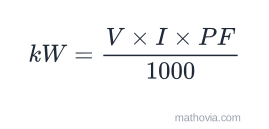
The amps to kW formula
Single-phase:
Three-phase, line-to-line voltage:
Worked example
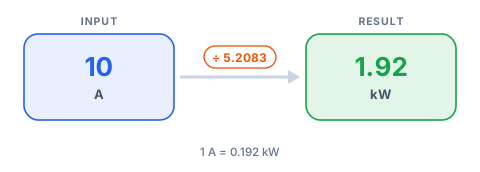
The calculator’s defaults are 10 A at 240 V, single-phase, at a power factor of 0.8.
Real power in watts:
To kilowatts:
If that same 10 A at 240 V were a resistive load — power factor 1 — it would be 2.4 kW. The 0.48 kW difference is the reactive share implied by an 0.8 power factor.
Amps to kW reference (single-phase, PF 1)
| Current | 120 V | 240 V |
|---|---|---|
| 5 A | 0.6 kW | 1.2 kW |
| 10 A | 1.2 kW | 2.4 kW |
| 15 A | 1.8 kW | 3.6 kW |
| 20 A | 2.4 kW | 4.8 kW |
| 30 A | 3.6 kW | 7.2 kW |
For a motor load, multiply each figure by its power factor; for three-phase, multiply by 1.732.
Turning kW into a cost
Once you have kilowatts, multiply by the hours of use for kilowatt-hours, then by your electricity rate. A 1.92 kW load run three hours a day is about 5.76 kWh daily, or roughly 173 kWh a month. See the kW to kWh calculator for that step.
Common mistakes
- Assuming power factor 1 for a motor, which overstates the kW.
- Wrong system type — single-phase selected for a three-phase load inflates the result by ~73%.
- Confusing kW with kVA. kVA ignores power factor and is always the larger figure.
For the reverse, use the kW to amps calculator. For apparent power, see amps to kVA.