
Why real power isn’t enough
You know a load needs 4 kW. You go to buy a generator or spec a transformer and find them rated in kVA. The two aren’t interchangeable: a 4 kW generator and a 4 kVA generator are different machines. Apparent power in kVA is what the source’s windings and conductors actually have to carry, and for any load with motors, transformers, or electronic supplies, that’s more than the real power it consumes.
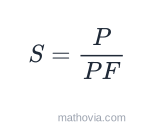
The gap is the power factor. A load at 0.8 power factor pulls 25% more current than its wattage alone would suggest, and that current — not the wattage — is what heats a transformer or loads an alternator. So sizing a source means converting the load’s kW into kVA first.
The kW to kVA formula
Worked example
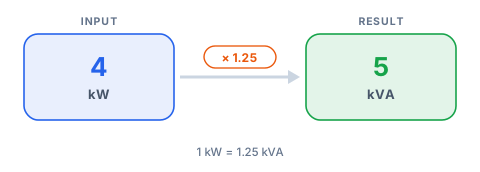
The calculator’s defaults are 4 kW at a power factor of 0.8.
The load does 4 kW of work but demands 5 kVA from the source. The reactive component is
kW to kVA by power factor
| Real power | PF 1.0 | PF 0.9 | PF 0.8 | PF 0.7 |
|---|---|---|---|---|
| 2 kW | 2.0 kVA | 2.22 kVA | 2.50 kVA | 2.86 kVA |
| 4 kW | 4.0 kVA | 4.44 kVA | 5.00 kVA | 5.71 kVA |
| 10 kW | 10.0 kVA | 11.1 kVA | 12.5 kVA | 14.3 kVA |
| 25 kW | 25.0 kVA | 27.8 kVA | 31.3 kVA | 35.7 kVA |
At a power factor of 0.7, a source has to be more than 40% larger in kVA than the load’s kW — the reason power factor correction is worth money on a large installation.
Sizing from the result
The kVA figure is the steady-state minimum. Real sizing adds margin:
- Motor starting can demand three to six times the running kVA for a second or two; a generator has to hold voltage through it.
- Non-linear loads (drives, LED drivers, IT gear) inject harmonics that raise the effective kVA a generator sees.
- Growth — leaving 20–25% spare is normal practice.
Common mistakes
- Using unity power factor for a motor load, which understates the kVA and can overload the source.
- Sizing a generator to the load’s kW rating while ignoring that its own rating is in kVA.
- Guessing the power factor when the motor nameplate prints it.
For the reverse, use the kVA to kW calculator. For the volt-amp version, see kW to VA, and for line current, kW to amps.
From kVA to current
Once you have kVA, the current follows from the supply voltage. For a three-phase supply:
A 50 kVA load on a 400 V three-phase supply draws about
Correcting the power factor
Capacitors can raise a low power factor, which lowers the kVA needed for the same kW. The reactive power to add is:
where