Mathovia

Electrical / Power & Wattage

Kilovolt-Amps (kVA) to Horsepower Conversion Calculator

Estimate motor horsepower from apparent power.

Horsepower
4.83 hp
Real Power
4.000 kW
002.52.4154.837.57.24109.65kVAhp5 kVA4.83 hp
1 kVA = 0.96515 hp

Use the stated electrical relationship and enter values in the displayed units.

Source: Formula conventions follow standard electrical engineering relationships. Verify equipment ratings and local code requirements before installation.

Written by
MPhil in Mathematics, Founder of Mathovia
Published

Mathematics verification: Mathematical formulas, calculations, worked examples and solutions are reviewed for accuracy before publication. How we check our work

Kilovolt-Amps (kVA) to Horsepower Conversion Calculator formula
The Kilovolt-Amps (kVA) to Horsepower Conversion formula

What size motor will this supply run?

When you know how much apparent power is available — a generator’s kVA rating, a spare transformer, the headroom on a feeder — the natural question is how large a motor it can drive. This calculation walks forward through the motor: from apparent power, through the power factor to real electrical power, through the efficiency to mechanical output, and finally into horsepower.

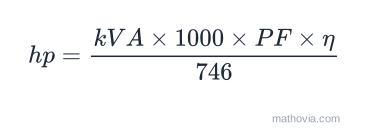
The kVA to horsepower formula

is apparent power in volt-amps. Multiplying by the power factor gives real power; multiplying by efficiency (a decimal) gives mechanical output; dividing by 746 converts to horsepower.

Worked example

The calculator’s defaults are 5 kVA, power factor 0.8, efficiency 90%.

Real power:

Mechanical output, then horsepower:

So 5 kVA supports about 4.83 hp of running motor load. You wouldn’t actually put a 4.8 hp motor on a 5 kVA generator, though — its starting inrush would stall the set. A 2 to 3 hp motor is a more realistic match.
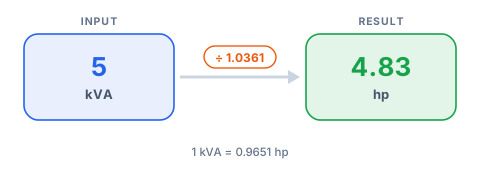
Kilovolt-Amps (kVA) to Horsepower Conversion Calculator worked example diagram
A visual read of the worked example above — the same numbers the calculator returns for its default inputs.

Running horsepower a source can carry

Power factor 0.85, efficiency 88%:

AvailableRunning hpRealistic motor (start margin)
3 kVA~3.0 hp1–1.5 hp
5 kVA~5.0 hp2–3 hp
10 kVA~10.0 hp5–7 hp
25 kVA~25 hp15 hp

The gap between the running figure and the realistic motor is the starting-inrush allowance.

What the estimate assumes

Efficiency and power factor use general defaults. Real values depend on the motor’s frame size, its load, and its manufacturer, and both fall when a motor runs lightly loaded. Use nameplate figures for an actual decision, and always keep starting current in mind.

Common mistakes

  • Matching a motor’s running hp to the source with no starting margin.
  • Dividing by power factor instead of multiplying in this direction.
  • Ignoring that partial load worsens power factor, raising the kVA a given motor actually needs.

For the reverse, use the horsepower to kVA calculator. For line current, see kVA to amps.

About the formula: Use the stated electrical relationship and enter values in the displayed units.

Frequently Asked Questions

How does this kVA to horsepower conversion work?+

Multiply apparent power by power factor to get real electrical power, multiply by efficiency for the mechanical output, then divide by 746 — the watts in one horsepower.

How big a motor can a 5 kVA generator run?+

About 4.8 hp of running load at a power factor of 0.8 and 90% efficiency. In practice you'd run a smaller motor — 2 to 3 hp — because the motor's starting surge can briefly need three or more times its running kVA.

Why multiply by power factor here but divide in the horsepower-to-kVA direction?+

Real power equals apparent power times power factor. Coming down from kVA to real power multiplies; going back up divides. Same relationship, opposite directions.

How accurate is this for a specific motor?+

It's an estimate. Efficiency and power factor vary with motor size, load, and maker. Plug in the actual nameplate values for an installation-ready number.

Does this tell me if my generator can start the motor?+

No — it's the steady-running figure. Starting a motor direct-on-line needs several times this kVA for a second or two, and a generator that can carry a motor's run load may still stall trying to start it.

What's the kW output the calculator also shows?+

It's the real electrical power (kVA × power factor), before the motor's own losses. The horsepower figure is that real power reduced by efficiency and converted to mechanical units.

Related calculators