
Why estimate motor current from horsepower
Before a motor is on site — while you’re planning a circuit, checking whether an existing feeder has room, or comparing a spec against a breaker size — the only number you have is the horsepower. This calculation turns that into an expected running current, given the voltage, phase, power factor, and efficiency.
It’s a planning figure, not a wiring figure. Motor circuits are sized from the full-load amps on the nameplate and the code tables, which fold in margins for starting current and continuous operation that a plain power calculation doesn’t carry.
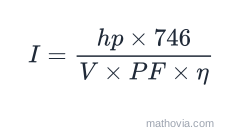
The horsepower to amps formula
Single-phase:
Three-phase, line-to-line voltage:
Worked example
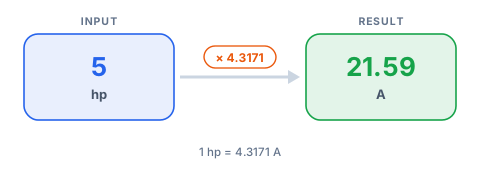
The calculator’s defaults are a 5 hp motor at 240 V, single-phase, power factor 0.8, efficiency 90%.
Mechanical output in watts:
Current:
So the motor draws about 21.6 A running. For comparison, the NEC table figure for a 5 hp single-phase 230 V motor is 15.2 A — the table assumes a better power factor and efficiency for that size — and it’s the table value, not this estimate, that sizes the conductors.
Approximate running current
Single-phase, PF 0.8, efficiency 88%:
| Motor | 120 V | 240 V |
|---|---|---|
| 1 hp | ~8.8 A | ~4.4 A |
| 2 hp | ~17.7 A | ~8.8 A |
| 3 hp | ~26.5 A | ~13.2 A |
| 5 hp | ~44 A | ~22 A |
| 7.5 hp | ~66 A | ~33 A |
Three-phase current per line is these figures divided by about 1.73.
Starting current is a separate problem
The result is steady running current. A motor started direct-on-line briefly draws locked-rotor current — typically 5 to 8 times the running figure — for a second or two while it comes up to speed. Breakers and overload relays for motor circuits are chosen with a time delay so they ride through that surge without tripping.
Common mistakes
- Sizing wire to this estimate instead of the nameplate FLA and code table.
- Ignoring the phase setting — a 73% error between single- and three-phase.
- Using efficiency and power factor of 1, which no real motor achieves.
For the reverse, use the amps to horsepower calculator. For sizing a supply, see horsepower to kVA.